
Sprouted Grain for Livestock Feed
10.18 -Sprouted Grain for Livestock Feed
Grace Hallahan, University of Guelph, Canada
Related video(s): Stocking fingerlings in a nursery pond (Source: Access Agriculture)
Suggested citation for this chapter.
Hallahan,G. (2026) Sprouted Grain for Livestock Feed, M.N. Raizada, University of Guelph, Canada. farmpedia.org
Introduction
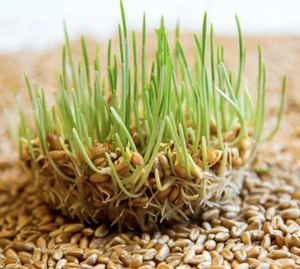
In many small-scale subsistence farms, livestock feed can be a challenge. Hydroponic grain sprouting represents a simple solution to this problem. Sprouted grain feed can improve the efficiency of feed by improving its nutritional value, thereby reducing how much feed must be produced in the field, along with the labour, acreage, water, fertilizer and storage facilities required (The Cattle Site, 2010). Sprouted grain, as shown in Figure 1, provides livestock with nutritious fodder. This chapter will investigate sprouted livestock feed for subsistence farms and provide further resources for farmers to get started.

Figure 1: Picture of sprouted grain with fodder growth for livestock feed (Rootz Organic, 2025).
Overall, a wide variety of seeds can be used for sprouting, including sorghum, making it an easily accessible resource for farmers in dry regions such as parts of Africa and South Asia. Below is a minimal list of effective crops that can be used for grain sprouting to feed livestock (Suma et al. 2020; see Reference List for additional sources):
- Sorghum
- Barley
- Flaxseed
- Corn (maize)
- Wheat
- Oats
- Cowpea
Benefits of sprouted grains
Increasingly popular among consumers, sprouted grains offer several benefits, including improved gut health through easier digestion and enhanced mineral and vitamin intake from seed germination (Suma et al. 2020). Fermentation during the sprouting process breaks down carbohydrates, reducing the energy required by animals for digestion, allowing this energy to be used for livestock growth (Zang et al., 2024). Sprouted grains can also improve the content of protein, fat and certain minerals (calcium, zinc and sodium) in the feed due to the fermentation process (Rico et al., 2020; Peer and Leeson, 1985). Barley sprouts provide high fibre intake, improving digestibility in large and small ruminant animals (Suma et al., 2020). Corn, barley, and other grains are primary crops used in agriculture, but as animal feed, they are typically added to other haylage or grasses to improve their nutrient value (Sokrab et al., 2012). Sprouted grains can be added to other feed such as grasses to provide animals with a well-rounded diet of grains and forages. In dairy cows, sprouted grains can increase milk fat percentages, increasing profit for small-scale farmers (Moallem et al., 2025). Certain grains, such as flaxseed, can drastically increase the percentage of vitamin C, which helps to improve immune function (Wang et al., 2015).
Whereas farmers suffer from uncontrollable weather patterns, jeopardizing traditional livestock feed production, sprouted grains can reduce the amount of feed grown and can be practiced year-round indoors with minimal sunlight and water (Suma et al. 2020). One study showed that growing sorghum or barley seeds in a warm environment helps to germinate seeds in 5-7 days (Suma et al. 2020). This is a short turnaround time for small-scale farmers to have readily available sprouted grains to feed to livestock.
Practical manual
One benefit of sprouted grain growth is that it can be adapted based on the needs of an individual farm. It is important to note that hygienic practices must be used when sprouting the grain, or it can lead to fungal molds and other pathogens that can infect livestock. For best results, farmers should prioritize watering each day during germination and ensure that there is adequate drainage to reduce the risk of mold, for example drainage holes in plastic containers.

Figure 2: Sprouted barley seeds in a plastic container (No Soil Solutions, n.d)
In general, sprouted grain seeds need to be placed in a moist, warm environment to sprout quickly. Seeds to be sprouted can be placed in any container, a damp towel or a clean floor. PVC pipes can also be used once cut in half. Plastic containers should have small holes made in the bottom to permit drainage to avoid root rotting. The steps to producing sprouted grains are summarized in Table 1:
Table 1. Steps to producing sprouted grains

See Helpful Links to Get Started (below), with more examples of fodder and sprouted seed innovations for small-scale farms
Overall, to produce 1 kilogram of sprouted grains, only 2-3 litres of water is needed (Suma et al. 2020). Livestock can eat the whole sprout and roots, or the greens (fodder) can be cut off to continue to reap a harvest from the grains. Production of larger sprouts can serve as an additional leafy feed for livestock and humans.
Critical analysis
As already mentioned, a concern with sprouted grains is the possibility of fungal mold growth (Soder et al. 2018), which can be reduced using proper water drainage. An article in the Applied Animal Science journal concluded that there is little production increase while feeding sprouted grains from a fodder production system (Soder et al. 2018). From this research, it is more economical for larger-scale farms to use a total mixed ration (TMR) rather than feeding a primarily sprouted grain diet (Soder et al. 2018). A summary of the costs and benefits of sprouted grains is noted in Table 2:

Conclusion
Sprouted grains offer an opportunity for small-scale farmers to enhance the nutrient intake of their livestock, improving their livestock feed efficiency, reducing labour required for the equivalent amount of field-grown feed, and taking advantage of year-round feed. It reduces weather uncertainty and livestock feed shortages, and is a simple technique requiring minimal training that helps to increase nutrient availability for livestock belonging to small-scale farmers.
Helpful links to get started
1. Link Access Agriculture sprouted grains for livestock feed
2. Link Sprouted grains for chicken feed. The chickens will eat from these containers, including the greens as well as the seeds
3. Link How to grow fodder (sprouted grains) for livestock. Using plastic containers that can be easily maneuvered to produce many sprouts, this video shows barley sprouts
4. Link Barley fodder for livestock. Video shows chickens, goats, rabbits and pigs eating the fodder. As well as some helpful cost and production overview
5. Link A short video showing soaked seeds, then being grown on a wet towel. An effective and cost-effective way for subsistence farmers to produce sprouts
6. Link In-depth tour of an American farmer's fodder system
References
1. Moallem, U., Livshits, J., Shpier, J., Alon, T., Shaani, Y., Kamer, H., Portnik, Y., & Leibovich, H. (2025). The effects of incorporating sprouted barley in diets of high-yielding dairy cows on production, efficiency, and nutrient digestibility. Animal. 19, 101598. 10.1016/J.ANIMAL.2025.101598
2. No Soil Solutions, (n.d). Link
3. Peer, D., & Leeson, S. (1985). Nutrient content of hydroponically sprouted barley. Animal Feed Science and Technology. 13, 191-202. 10.1016/0377-8401(85)90022-7
4. Rico, D., Penas, E., del Carmen Garcia, M., Martinez-Villalugenga, C., Rai, D., Birsan, R., Frias, J., & Martin-Diana, A. J. (2020). Sprouted barley flour is a nutritious and functional ingredient. Foods. 9, 296. 10.3390/FOODS9030296
5. Rootz Organic, 2025. Sprouted Grains: A Smarter Choice for Gut Health, Energy, and Better Nutrition. Link
6. Suma, TC. Kamat, V., TR, S., & Reddy, M. (2020). Review on hydroponics green fodder production: Enhancement of nutrient and water use efficiency. International Journal of Chemical Studies, 8, 2096-2102. 10.22271/chemi.2020.v8.i2af.9060
7. Soder, K., Heins, B., Chester-Jones, H., Halfla, A., & Rubano, M. (2018). Evaluation of fodder production systems for organic dairy farms. Professional Animal Scientist. 34, 75-83. 10.15232/pas.2017-01676
8. Sokrab, A., Mohamed Ahmed, I., & Babiker, E. (2012). Effect of germination on antinutritional factors, total, and extractable minerals of high and low phytate corn (Zea mays L.) genotypes. Journal of the Saudi Society of Agricultural Sciences, 11, 123-128. 10.1016/J.JSSAS.2012.02.002
9. The Cattle Site (2010), Feeding Flood-Damaged or Sprouted Crops to Livestock. Link
10. Wang, H., Qiu, C., Abbasi, A., Chen, G., You, L., Li, T., Fu, X., Wang, Y., Guo, X., & Liu, R. (2015). Effect of germination on vitamin C, phenolic compounds and antioxidant activity in flaxseed (Linum usitatissimum L.). International Journal of Food Science and Technology, 50, 2545–2553. 10.1111/IJFS.12922
11. Zang, Y., Richards, A., Seneviratne, N., Gutierrez-Oviedo, F., Harding, R., Ranathunga, S., & McFadden, J. (2024). Replacing conventional concentrates with sprouted barley or wheat: Effects on lactational performance, nutrient digestibility, and milk fatty acid profile in dairy cows. Journal of Dairy Science, 107, 5529-5541. 10.3168/jds.2023-24071