
Plastic Shelters to Combat Tomato Late Blight
7.22 -Plastic Shelters to Combat Tomato Late Blight
Alan McLachlan, University of Guelph, Canada
Suggested citation for this chapter.
McLachlan,A. (2026) Plastic Shelters to Combat Tomato Late Blight, The Encyclopedia for Small Scale Farmers. Editor, M.N. Raizada, University of Guelph, Canada. farmpedia.org
Introduction
Tomatoes are a high-value crop and are among the most important crops cultivated around the world. In Ethiopia they are ranked 5th in annual national vegetable production (CSA 2022). Tomatoes are produced during both the rainy and dry seasons; as a result, they are prone to pests and diseases (Sako & Demissie, 2023). The most significant disease caused by fungi is late blight. Tomato late blight is caused by an oomycete, a fungus-like organism (Phytophthora infestans) (Sako & Demissie, 2023). Tomato late blight results in yield losses, which leads to significant reductions in supply and income losses for smallholder farmers (Sako & Demissie, 2023). Although late blight is primarily an airborne disease that is transmitted through wind and splashing, it can build up in the soil which can negatively impact future crops (Sako & Demissie, 2023). Historically, late blight caused the Irish Famine during the 1840s through its catastrophic impact on potatoes (Lamour et al., 2007). The average loss in Ethiopia caused by the disease was reported to be between 65-70% and there have also been reports of crop losses of 100% (Kassa and Woldegiorgis, 2000).
Plastic Shelters as a Potential Feasible Solution for Smallholder Farmers
Although the use of fungicides is seen by many as the most effective solution, fungicides are costly and potentially hazardous to human life and the environment (Tegegne et al., 2021). The use of plastic shelters for tomato production presents itself as a way to create an optimal microclimate for tomato growth, improving yields and quality (Tegegne et al., 2021).
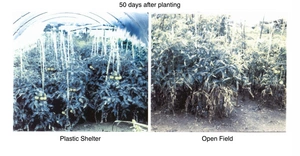
Soil splash occurs when intense rainstorms cause soil particles to spread onto plants, leaving them at risk of the pathogens that are in the soil (Tegegne et al., 2021); plastic shelters (Figure 1) can prevent this. Through a study done in Belize that compared tomatoes grown in plastic shelters with those grown in open-field environments, it was found that on average, tomato yields increased by 169% in plastic shelters (Arya et al., 2000). It was also found that tomatoes grown in plastic shelters required no pesticide application while those in open-field environments required repeated use (Arya et al., 2000). Plastic shelters allowed for three quality crops of tomatoes to be grown annually rather than one (Arya et al., 2000). This significantly increases profits for farmers. Furthermore, land degradation that occurs in open-field environments did not occur under plastic shelters, which allowed these spaces to be continuously used for several years (Arya et al., 2000). Additionally, tomatoes planted in these shelters were individually hand watered, limiting water usage and controlling weeds as water was not spread to other areas of the soil (Arya et al., 2000).


Figure 1: Highlighting the impacts of growing tomatoes under plastic shelters compared to open-field production in Belize, Central America, 1994-95. Source: Arya et al. (2000)
Figure 2 highlights the effectiveness of plastic shelters in dealing with late blight and other harmful fungal diseases. The data presented emphasized that unprotected crops can be entirely decimated while protected crops continue to thrive, giving farmers nearly guaranteed yields.
Benefits of Growing Tomatoes Under Plastic Shelters
In a study conducted in Ethiopia by the Ethiopian Institute of Agricultural Research, they analyzed the impact of plastic shelters on the production of the Melka salsa and Melka shola varieties of tomato. In their study, the plastic shelters that they used were made of local materials that can easily be sourced (wood, bamboo); they constructed their shelters in an A-frame (Tegegne et al., 2021). The relative yield produced from the Melka salsa variety using the shelter was 114.5% better than production without the shelter (Tegegne et al., 2021). The Melka shola variety had a 98.4% relative yield advantage when grown under shelter (Tegegne et al., 2021). The results indicated that a small investment to build the shelters would generate a higher net income (Tegegne et al., 2021). On one hectare of land, this translated to $172.28 USD for Melka salsa variety and $113.60 USD for Melka shola (Tegegne et al., 2021). Furthermore, growing the Melka salsa variety under a plastic shelter increased net profits by 530% and by 35% for the Melka shola variety (Tegegne et al., 2021). A survey was conducted with the farmers who participated, and they found that the farmers appreciated the positive increases in yields and saw that they would benefit from using shelters (Tegegne et al., 2021). The increased profits generated from the use of plastic shelters would improve food security and allow farmers to allocate income towards education.


Figure 2: The process of constructing a plastic shelter: (a) shows the construction of the frame, (b) shows the finished shelter with the plastic covering, Belize, Central America. Source: Arya et al. (2000)
Figure 2 presents the structural requirements of effective plastic shelters. As shown, level ground is necessary for water distribution and structural stability, and a height of at least 2.5 meters allows for effective tomato crop growth. The image furthers the effectiveness of the shelter through its depiction of the side ventilation which regulates temperature, and humidity through adequate airflow.
The Construction of Plastic Shelters
While the materials to build the frame of the plastic shelters can be adjusted to suit a farmer’s budget and access to resources, the importance of the UV-resistant plastic remains constant across designs. In Belize, researchers used PVC pipes and galvanized steel; on the other hand, in Ethiopia, farmers were able to use bamboo and wood which were the resources that they had access to (Tegegne et al., 2021). This emphasizes the versatility of this intervention; provided that there is access to UV-resistant plastic coverings, smallholder farmers can successfully implement these structures (Arya et al., 2000). The choice of material for the frame will impact the lifespan of the structure but will not directly impact the structure’s effectiveness in managing late blight (Arya et al., 2000).
Step-by-Step Procedure:
1. Site selection: Choose the most level area available to allow for adequate drainage.
i. Rotate the structure so that it is south facing to allow for the sun to disperse light equally to all tomatoes.
2. Foundation: Dig holes in the ground around 60 centimetres deep for 12 posts.
i. Secure posts with packed soil and gravel.
ii. Ensure that the central posts are at least 2.5 metres high to allow for adequate tomato growth and heat dispersion.
3. The A-Frame: Connect the rafters of the roof at a 45-degree angle.
i. It is crucial that the pitch is steep to prevent rain from pooling on the plastic which can cause the structure to collapse.
4. Plastic Tensioning: If possible, wait for a warm morning to pull the plastic over the frame as plastic is easier to maneuver in warmer weather.
i. Secure the plastic with the use of clamps or nails and screws.
ii. Ensure that the plastic is tightly fastened as if it is loose, this risks tearing.
5. Ventilation Management: Leave 50 centimetres at the bottom of the side walls open for airflow.
Additional Construction:
Since the structure will block out rainwater completely, in order to use this resource, it is important to construct gutters/water catchers (Arya et al., 2000). Figure 2 demonstrates this through the wood on the side of the structure which allows rainwater to be collected.
Critical analysis:
The initial investment of plastic shelters is significant and could be a limitation for smallholder farmers; however, depending on the materials and labour used to construct the structures, these costs can be lessened. The UV-resistant plastic used in this method is a constraint through its lifecycle, as well as its environmental impact. The UV-resistant plastic has a lifetime of 3 years before it needs to be replaced (Arya et al., 2000). This can cause serious financial burdens to be placed on farmers if the timing of the re-purchasing of the film is not aligned with the maintenance of the structure. Through access to important information, farmers would be able to coordinate the re-purchasing of the plastic, and this challenge would be offset. Another challenge is the environmental cost of the plastic once it can no longer be used. Traditional practices would burn the plastic, and this would lead to toxins being released into the soil. A solution for this would be to encourage farmers to reuse the plastic as a mulch or lining for other crops or as otherwise possible.
The construction of these shelters is very labour intensive, and traditionally the perception is that this work should be done by males. As a result, female-headed households would suffer from higher costs to hire male labourers for construction and maintenance. Even though there is potential for labour-sharing, formal labour support groups currently reach only 17% of Africa (UNDP, 2025). Consequently, the African Union Commission and the United Nations Development Programme have urged governments and financial institutions to support the expansion of these groups to allow for improved technological adoption (UNDP, 2025).
Conclusion
In conclusion, plastic shelters are an economically feasible solution to allow smallholder farmers to handle tomato late blight in an effective and sustainable way. With correct installation, these shelters offer increased yields, profitability, and limit the use of harmful pesticides. To offset the initial investments of these structures, it is important for smallholder farmers to be connected to allow for credit systems to be developed to support them. Once these are put in place, farmers will be able to benefit from the increased profits that tomatoes grown under these structures generate.
Helpful Links To Get Started
Link FAO
Link British Columbia, Canada
Link Presentation from the U.K.
Link International Potato Institute
Link Government of Ontario, Canada
Link Example Construction of Other Shelters: Video - Access Agriculture
Picture based lessons: Please refer to page 39-40-41: Sub-Saharan Africa / Caribbean Pictures – SAK Book Please refer 32,33,34: Sub-Saharan Africa / Caribbean English Captions – SAK Book
Link Inexpensive Materials from Alibaba: UV-Resistant Plastic
Link PVC Pipes
Link Structure Posts
Link Structure Posts (alternate)
Link Tomato Stakes
Link Rainwater Gutters
Link Rainwater Gutters (alternate)
References
Arya, L. M., Pulver, E. L., & van Genuchten, M. T. (2000). Economic, environmental, and natural resource benefits in vegetable production in a humid tropical environment. Journal of Sustainable Agriculture, 17(2), 124-142. Link
CSA. (2022). Agricultural Sample Survey 2021/2022: Report on area and production of major crops. Volume 1. Ethiopian Statistics Service, Addis Ababa. Link
Kassa, B., & Woldegiorgis, G. (2000). Effect of planting date on late blight severity and tuber yield on different potato varieties. Pest Management Journal of Ethiopia, 4, 51-63. Link
Lamour, K. H., Win, J., & Kamoun, S. (2007). Oomycete genomics: new insights and future directions. FEMS Microbiology Letters, 274(1), 1-8. 10.1111/j.1574-6968.2007.00786.x.
Sako, A. K., & Demissie, Y. T. (2023). Overview of management practices of tomato late blight (Phytophthora infestans) disease. International Journal of Research in Agricultural Sciences, 10(4), 2348-3997. Link
Tegegne, M. A., Melaku, E., & Ayichew, S. (2021). Economic feasibility of plastic shelter tomato production method under rain-fed in Fogera plain, North Western Ethiopia. International Journal of Advanced Research in Biological Sciences, 8(12), 142-147. 10.22192/ijarbs
UNDP. (2025, October 8). Africa's real safety net: AU and UNDP launch a landmark report on community-based social protection. UNDP Africa. Link