
Growing Healthy Bananas and Plantains from Suckers
1.12 - Growing healthy bananas and plantains from suckers
Isaac Elson, University of Guelph, Canada
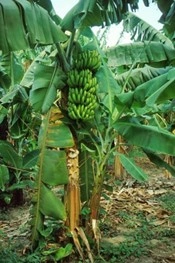
Related video(s): Producing healthy plantain and banana suckers (Source: Access Agriculture)
Suggested citation for this chapter.
Elson, I. (2026) Growing healthy bananas and plantains from suckers. In Farmpedia, The Encyclopedia for Small Scale Farmers. Editor, M.N. Raizada, University of Guelph, Canada. farmpedia.org
Background for producing bananas and plantains using suckers
Bananas and plantains are critically important to many small-scale farmers. Bananas are especially important in East Africa: they provide income as well as nutrition to both children and adults and are a big part of local cultures (Kilimo Kwanza, 2023). Plantains are also very important economically for East Africans as they are used not only for food and income, but also for making raw materials (Phillip et al., 2009; Fakayode et al., 2011). Plantain production depends on farm size, the number of banana/plantain plants, and the number of hired laborers or family help. Costs for the plantains depend on the price of the plants, labour, and land costs (Joel et al., 2022).
Whereas many crops are propagated from seeds, bananas/plantains are propagated asexually from suckers. A sucker is a small banana seedling that grows at the base of the main plant, i.e., a mother plant (Vézina et al., 2020). This helps the plants to keep growing without seeds. The suckers then grow and provide a steady supply of shoots that can make fruits. This chapter describes how small scale farmers can propagate bananas and plantains from suckers under field conditions.
Suckers are used for planting by cutting them from the main plant and putting them in a new location in the field (see Figure 1) (Vézina et al., 2020).

Alternatively, commercial farmers sometimes propagate suckers through tissue culture, which involves taking meristematic shoot tissue and then growing it in a healthy, sterile indoor environment using jars (see Figure 2) (Crop Development, n.d.).

Many plants can be grown from a single parent plant through plant tissue culture, and fewer diseases will occur, partly because of the sterile environment, and addition of heat or fungicide treatment to kill pathogens, as well as the fact that tissue culture allows plants to be grown all year (Agriculture Institute, 2025). The problem with tissue culture is its expensive setup, with very specific equipment and technical expertise needed (Agriculture Institute, 2025). There is also the fact that the plantlets are more fragile than the ones grown in fields, so they need to be adapted slowly to the outside before they can be released to the field (Agriculture Institute, 2025).
Inexpensive field-based propagation of bananas by small scale farmers: Step by step guide
As an alternative to indoor plant tissue culture, small-scale farmers can inexpensively propagate bananas and plantains from suckers directly under field conditions. In-field propagation makes it possible for farmers to multiply one mother plant into 10-60 plants in just a few months. The process involves selecting young shoots from the base of the mother plant to create new, identical plants. This is shown step by step below (Figures 3-14) (Mfantseman Municipal Assembly - Dept. of Agriculture, 2024).
Step 1

Step 2

Step 3
Step 4

Step 5

Step 6

Step 7

Step 8

Step 9

Step 10

Step 11

Step 12

Techniques to optimize field-based propagation via suckers
Sword suckers are shoots from bananas and plantains that are used to grow new plants. The use of sword suckers is seen as the best propagation technique because of their strong connection to the mother plant, which enables nutrient transfer, and because they grow quickly. The suckers are easy to access, cheap, and cause little work in the field (Kulimbe et al., 2021). They start with small, curly leaves and usually do not develop their true leaves until they are 1 to 3 feet tall. They are strong and thick, especially at the base, and grow very close to the main plant, often touching it. Because they can photosynthesize efficiently, they will produce a large, healthy bunch of fruit much more quickly than water suckers (Third Insight Design, 2023).
For additional techniques to optimize field-based propagation via suckers, it is beneficial for farmers to use fungicides, as these prevent damping-off diseases, reduce rotting of the stem and root, increase rooting success, and support weaker plants (Mamalyn's Garden, n.d.). Farmers can also add fertilizers at this stage to improve growth, as several studies show that fertilization rate and plant spacing affect how many new shoots grow, how tall the plants get, and how many leaves are produced (Hs et al., 2020). A macropropagation chamber using sawdust (see Figure 8) combined with in-field decapitation (see Figures 6 and 7) has been shown to produce the greatest number of strong, healthy suckers (Sefasi et al., 2025). Shading the plants improves sucker survival by reducing water stress, preventing drying out, and creating favourable conditions for root establishment (Leatherwood et al., 2026). Hands and tools should always be washed between planting suckers to prevent the spread of pathogens (Blomme et al., 2017).
Benefits
Use of field-based suckers allows farmers to grow many plants from just one mother plant, which is time efficient (Alliance of Bioversity International and CIAT, IITA, CGIAR, 2021). Indeed, farmers can grow 50 healthy suckers from one mother plant in less than two months if the suckers are cleaned and raised using sawdust and a germination box (Boss, 2008). It is an inexpensive way to grow these crops, and there is genetic consistency between parent and offspring because of the asexual propagation process (Kulimbe et al., 2021).
Optimized field-based use of suckers helps farmers grow more plants without the need for expensive tissue culture. It can also increase the number of suckers produced from 5-20 to over 100 per year (Sefasi et al., 2025). Optimized macropropagation can produce up to 1000 plantlets per mother corm within 8 months (Tumuhimbise and Talengera, 2018). The quality of the resulting plants also increases.
Critical Analysis
The problem with the use of suckers is that, if tissue culture is not applied, there is a risk of transferring pests and diseases to the new plants (Kulimbe et al., 2021). There is also a lack of improved cultivars that resist pathogens and diseases when suckers are used (Njukwe et al., 2013). Failing to wash bulbs can be a safety issue, and if soil is not kept away from the bulbs, diseases can pass from the suckers to the resulting plants (Njukwe et al., 2007). For example, suckers can carry viruses that are transmitted to the next generation (WSU Tree Fruit, n.d.). There is also a lower multiplication rate when suckers are used under field conditions, along with an added risk of mixing up different plant varieties in the field (Kulimbe et al., 2021).
On the positive side, this innovation does not require any special tools, only a knife or a bucket. The technique can be done with little training and few resources, so even small-scale, remote farmers can grow bananas and plantains with materials that are available locally (Boss, 2008). The process is not labour-intensive, though the suckers can be difficult to transport for fear that they will die in transit (Njukwe et al., 2013).
Conclusion
The innovation of sucker-based propagation has made it easier and more time-efficient for small-scale farmers to produce banana and plantain crops, including in East Africa, while maintaining a steady income and providing an abundance of nutrient-rich food for their families. Plant tissue culture adds to the process by reducing crop diseases, but it is expensive and requires technical expertise and equipment. By contrast, small-scale farmers can use field-based suckers, combined with improved techniques, as a reliable and inexpensive approach to propagating bananas and plantains.
Practical Resources to Get Started
Access Agriculture: Producing healthy plantain and banana suckers (2022)
The Garden Nerd: Divide & Propagate Banana Plants - Free Bananas For Life (2022)
Kiruwa, F.H., Mlinga, E.E., Aloyce, A.A. and Shimwela, M.M. (2024) Best practices for initiation of banana and plantain (Musa spp.) cultures. Journal of Plant Biotechnology. DOI
Ngo-Samnick, E.L. (2011) Improved plantain production. CGIAR. Link
A. Bassa & Sons: Inexpensive machetes for sucker propagation
References
1. Agriculture Institute. (2025). Methods of banana propagation: Suckers, rhizomes, and tissue culture - agriculture notes. Link
2. Alliance of Bioversity International and CIAT, IITA, CGIAR. (2021). Healthy banana and plantain planting material for Africa. CGIAR System. Link
3. Blomme, G. et al. (2017). Bacterial diseases of bananas and enset: Current state of knowledge and integrated approaches toward sustainable management. Frontiers in Plant Science, 8, 1290. Link
4. Boss, D. (2008). Rapid multiplication of banana and plantain plants. ECHO Development Notes, no. 99. Link
5. Crop Development. (n.d.). Banana tissue culture. Link
6. Joel, L., Jongur, A.A.U., Adebayo, E.F., and Michael, A. (2022). Economics of plantain production among farmers in Northeast Nigeria. Turkish Journal of Agriculture - Food Science and Technology, 10(4), 536-541. Link
7. Kilimo Kwanza. (2023). Empowering East African communities through the power of bananas. Link
8. Kulimbe, I., Ariina, M.M.S., Lohe, V., Pertin, M., and Anna, Y. (2021). Advances in propagation techniques of banana. Just Agriculture, 2, 008. Link
9. Leatherwood, R., Lopez, R., and Enfield, A. (2026). Managing the cuttings' environment. Greenhouse Product News. Link
10. Mamalyn's Garden. (n.d.). Benefits of using fungicide in cuttings propagation. Facebook. Link
11. Mfantseman Municipal Assembly - Dept. of Agriculture. (2024). Detailed step-by-step guide to making your own plantain sucker seedlings. Facebook. Link
12. Njukwe, E., Ouma, E., van Asten, P.J.A., Muchunguzi, P., and Amah, D. (2013). Challenges and opportunities for macropropagation technology for Musa spp. among smallholder farmers and small and medium-scale enterprises. In G. Blomme, P. van Asten, and B. Vanlauwe (Eds.), Banana Systems in the Humid Highlands of Sub-Saharan Africa: Enhancing Resilience and Productivity (pp. 66-71). CABI. Link
13. Njukwe, E., Tenkouano, A., Amah, D., Sadik, K., Muchunguzi, P., Nyine, M., and Dubois, T. (2007). Training manual: Macro-propagation of banana and plantain. IITA, Ibadan, Nigeria. Link
14. Staver, C., and Lescot, T. (2015). Key practices for desert banana, plantain, and cooking banana: Illustrated guide. CIRAD, France. Link
15. Sefasi, A., Nyasulu, M., Pute, K., Kamanga, R.M., Nyalugwe, E., Matiki, L., Gada, Y., and Chimungu, J. (2025). Optimization of banana sucker production using different macropropagation structures and substrate [v1]. Preprints.org. Link
16. Third Insight Design. (2023). Not all bananas are created equal. Third Insight Design & Nursery. Link
17. Tumuhimbise, R., and Talengera, D. (2018). Improved propagation techniques to enhance the productivity of banana (Musa spp.). De Gruyter Brill. Link
18. Vézina, A., Turner, D.W., and Gibbs, J. (2020). Banana sucker. ProMusa: Improving the understanding of banana. Link
19. WSU Tree Fruit. (n.d.). Manage root suckers - a component of integrated X-disease management. Washington State University, USA.