
Fish Waste as Organic Fertilizer
4.37 - Fish Waste as Organic Fertilizer
Jordan Walton, University of Guelph, Canada
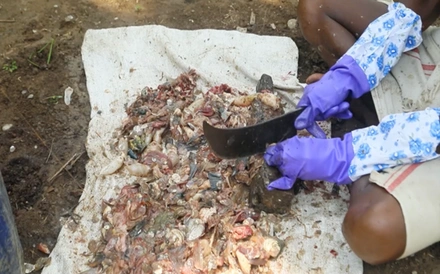
Figure 1. Fish waste being prepared for fermentation (Source: Access Agriculture). https://www.accessagriculture.org/turning-fish-waste-fertilizer?cat_id=106
Suggested citation for this chapter.
Walton, J. (2026) Fish Waste as Organic Fertilizer. In Farmpedia, The Encyclopedia for Small Scale Farmers. Editor, M.N. Raizada, University of Guelph, Canada. farmpedia.org
Background
Commercial fishing poses a sustainability issue globally, with between 30-70% of processed fish discarded as waste byproducts (Ahuja et al., 2020). Additionally, the use of commercial fertilizers can decrease plant nitrogen uptake, harm soil bacteria, and potentially lead to leaching or runoff (Ekinci et al., 2019). The addition of organic matter alongside safe levels of commercial fertilizer can reduce the negative impacts of fertilizer use, as organic matter (i.e. from fish waste) supports soil structure, provides essential nutrients, and promotes soil biodiversity (Ekinci et al., 2019).
Fish waste (FW) can act both as organic matter for soil supplementation and improve sustainability practices while decreasing waste. Fish waste fertilizer (FWF) offers a low-cost, sustainable fertilizer supplement that enriches soil nutrient quality, crop yield, and crop mineral content. FWF is not only comprised of fish processing waste (see Figure 1), but is part of an organic formula that, for example in South Asia, includes some form of organic compost, and raw sugar (see Figure 2), or jaggery (Ajmal Siddique et al., 2023); jaggery is a boiled and solidified sugarcane extract. "Fish waste" describes the portion of a processed fish that is not considered edible or typically thrown away, including but not limited to: viscera (12–18% of total fish weight), bones (9–15%), heads (9–12%), scales (~5%), and skin (1–3%) (Murugan et al., 2024). Through a short fermentation process ranging from 1.5 to 2 months, FWF can be applied as a foliar spray onto crops or directly to soil as compost to offer a diversity of nutritional benefits to soil and plant health (Ajmal Siddique et al., 2023).

Figure 1. Fish waste being prepared for fermentation (Source: Access Agriculture). https://www.accessagriculture.org/turning-fish-waste-fertilizer?cat_id=106

Figure 2. Raw sugar being prepared for the fermentation process (Source: Access Agriculture). https://www.accessagriculture.org/turning-fish-waste-fertilizer?cat_id=106
Benefits to Adoption of Fish Waste Fertilizer (FWF)
Several macronutrients are particularly important for plant development: nitrogen (N), potassium (K), phosphorus (P), and calcium (Ca) (Ahuja et al., 2020). FWF contains these nutrients. Whole fish captured inland in Bangladesh showed a ratio of 120:11:13 g/kg dry matter of N-P-K (Bogard et al., 2015; Ahuja et al., 2020) along with calcium from the bones. Marine caught fish demonstrated a similar ratio, of 130:16:11 g/kg dry matter plus calcium. Notably, the composition of nutrients will vary with each individual fish, based on size and species (Bogard et al., 2015; Ahuja et al., 2020).
FWF also has the potential to increase a farmer's crop yield and nutrient content. An organic FWF compost composed of 80% fish waste and 20% pine bark, with a combined N content of ~11 g/kg, was shown to increase ice lettuce (L. sativa L.) fresh matter yield by ~93%, as well as ~46% in dry matter, compared to a control pot which received no fertilization, grown in 10 kg of soil (Radziemska et al., 2018). Fish waste and pine bark compost also increased the macronutrient content of the lettuce by ~79% for N, ~62% for P, ~56% for K, ~44% for sodium (Na), and ~39% for both Ca and magnesium (Mg), when compared to the same control group (Radziemska et al., 2018). Similar yield-increasing results could be seen in Kalmegh (Andrographis paniculata Nees, a medicinal crop), grown in a vermicompost, with fish amino acid (FAA: pseudonym for FWF) applied as a foliar spray, and a 3:97 dilution ratio of FAA/water (Nadehiya Devi et al., 2024). When grown in vermicompost (5 t/ha) with application of foliar FAA (3%), a fresh herbage yield increase of ~126% was demonstrated, in comparison to a control group that received no additional fertilization. In addition, this same vermicompost/FAA (at 5 t/ha, 3%) trial saw the highest nutrient uptake, with a crop N-P-K content of ~39-7-84 kg/ha, whereas the control group content was ~22-1-20 kg/ha (Nadehiya Devi et al., 2024). An increase in macronutrient content in a farmer's crop may aid in addressing dietary deficiency concerns, and an increase in yield may also improve a farmer's commercial profits.
Additionally, FWF presents several opportunities to increase soil and plant health, in addition to potential yield increases. Soil salinity, a measure of soluble salts contained in soil, can pose significant stress for plants; if salinity is too high, it may decrease uptake of K, Ca, Mg, and nitrate (NO3) (Mahdavi et al., 2024). Measured in stevia plants (Stevia rebaudiana Bertoni), the application of foliar FWF produced from silver carp (Hypophthalmichthys molitrix) waste, water (1:5 ratio waste to water), brown sugar (150 g), and 30 mL protein-hydrolyzing bacteria (Bacillus subtilis) showed a variety of benefits for plants exposed to increased salinity conditions. Under increased salinity levels (60 mM sodium chloride [NaCl]), foliar FWF application increased the potassium (K) (ranging 1-4%) content in stevia roots whilst increasing calcium (ranging 0.15-0.25%) in plant shoots, in comparison to a control group that received no treatment under the same 60 mM NaCl salinity condition (Mahdavi et al., 2024). Calcium acts as a signaling molecule in plants, including by promoting root and root hair growth in plants (An et al., 2024). Fish bones, when prepared into a bonemeal, offer a strong supplemental source of calcium, potassium, and phosphorus, offering an alternative to fish waste use as a soil supplement. Produced from fringescale sardinellas (Sardinella fimbriata), a bonemeal with a Ca-K-P composition of ~1-106-1 g/kg was obtained (Khairul et al., 2024). Addition of FW bonemeal to soil may offer substantial nutrient-enriching potential.
Stepwise Guide
The preparation of FWF is simple, as fish waste can be fermented into either a foliar-applicable spray or decomposed into soil compost (Access Agriculture, 2022).
Materials: 3 kg FW/10 L FW liquid, 3 kg raw sugar (or molasses)/10 L FW liquid, varying quantity (L) of water, depending on method of preparation.
Note: FW and sugar can easily be obtained from a local market or fishery.
Step 1. Chop the 3 kg of FW into small pieces.
Step 2. Add 3 kg of sugar or molasses, mix well so that waste is coated.
Step 3. Pour mixture into a bucket (preferably plastic, as metal may interfere with microbes partaking in the fermentation process).
Step 4. Cover with an airtight lid and place in the shade out of the sun.
Step 5. Stir once a day; after 4 weeks the fermentation process will be complete, during which a slightly rotten smell may develop. Note: the smell may attract animals, so ensure the bucket is inaccessible to wildlife.
Step 6. Filter out the liquid from the FW with a thick cloth or sieve; transfer the liquid into airtight containers, where it can be stored in the shade for up to 3 months. Note: to dispose of solid FW safely, first wash it with water to rid the waste of the smell, then it can be safely composted in the ground.
Step 7. Dilute FW liquid in varying ratios depending on desired crop.
For cereals and vegetables, a 10:1 water/FW liquid (L) will produce enough foliar spray for 400 m², spraying twice during the growing season. For tree crops, a ratio of 10:2 water/FW liquid (L) spray is required to cover all leaves. For ground crops which require mulching, add FW foliar spray directly to soil during the mulching process, with a ratio of 50:5 water/FW liquid (L), which is enough to cover 2000 m² (Access Agriculture, 2022).
Notes: If a scale is unavailable for precise measurement, FWF spray may still be produced using equal parts of FW and raw sugar. If it is possible to effectively separate bones from solid waste after fermentation, farmers may be able to crush bones into FW bonemeal for soil supplementation.
Solid Fish Waste (FW) Fertilizer (100 kg FW Compost)
Materials: 30 kg FW/100 kg FW compost, 5 kg raw sugar (or molasses)/100 kg FW compost, 75 kg dry, decomposed manure/100 kg FW compost (Access Agriculture, 2022). Note: FW and sugar can easily be obtained from a local market or fishery. Dried cow manure can be obtained from livestock or nearby farmers.
Step 1. Dig a pit approximately ½ metre wide x ½ metre deep. Size will vary depending on the quantity of fertilizer desired.
Step 2. Chop 30 kg FW into small pieces.
Step 3. Add 5 kg sugar or molasses to chopped FW, forming a pile; mix well so that waste is coated in sugar.
Step 4. Add and mix 65 kg of dry, decomposed manure to the pile.
Notes: Dry manure can be prepared by drying manure in the sun for several months after being collected. Adding fertile soil can help speed up the fermentation process, as microbes in soil aid in decomposition.
Step 5. Transfer the mixture into the pit, and cover with large leaves, to prevent sunlight from harming microbes taking part in decomposition. Leaves also allow for the release of gas during the fermentation process.
Notes: If it rains, cover the mixture with a tarp. The cow dung will overpower the FW smell, so animals should not be a concern.
Step 6. After 2 months, decomposition is complete, and solid FW fertilizer is ready.
Step 7. Apply 20 kg solid FW fertilizer and 10 kg dry, decomposed cow dung onto soil. This is enough for 200 m² (Access Agriculture, 2022).
Critical Analysis, Constraints to Adoption, and Sustainability
FWF offers a valuable, accessible resource for farmers in the form of plant and soil supplementation, with relatively low input costs. Data retrieved from the International Monetary Fund (IMF) indicates that global commodity prices of sugar are currently $0.33 USD/lb, or $0.74 USD/kg (IMF, 2026). Data from last year shows global commodity prices of several commercial staple fish average $7.82 USD/kg (IMF, 2025). Farmers may also have the opportunity to purchase FW directly from local market sellers, likely at a much lower cost than edible fish; however, data is not available on FW pricing. For example, following the stepwise guide provided in this chapter, 10 L of FW liquid foliar spray (sufficient to cover 400 m², spraying twice), with inputs of 3 kg FW and 3 kg raw sugar (Access Agriculture, 2022), will cost $25.67 USD on average. Additional input costs may include buckets, foliar spray application equipment, etc. However, manufactured goods vary largely in cost from local manufacturers, and thus standardized data is not easily accessible.
FWF does present labour and opportunity cost constraints. Depending on the method of production, FWF may require between 2-6 months of short daily care to prepare (Ajmal Siddique et al., 2023), which may limit a farmer's ability to leave the farm for periods of time during preparation. Additionally, FW could just as easily be dried and ground into a livestock feed known as fish meal (de Koning, 2005), presenting an alternative revenue source.
FWF also may pose several non-labour constraints to adoption. Production of FWF at a low cost relies heavily on the availability of local fish, therefore potentially restricting the practice to farms located close to rivers, lakes and/or oceans; this may be further exacerbated by seasonal fishing practices.
For success within the fermentation process, the container should be kept in an area that is inaccessible to wildlife, as well as out of the sun (Shama & Nimalan, 2023). Given the smell of fermentation, wildlife disruption may pose a constraint to preparation or application.
Farmers must also be aware of potential bodily dangers present in the process of FWF production, such as bone fragment sharpness during FW processing, as well as ensuring nobody within their family and community is allergic to fish proteins present in waste, foliar spray, and compost. FWF production and use promote sustainable agricultural practices. Application of FAA as foliar spray can reduce soil nutrient runoff and leaching, decreasing proximal pollution when applied in conjunction with commercial fertilizers (Ajmal Siddique et al., 2023). FWF application not only increases plant health under high salinity conditions as shown in Mahdavi et al. (2024), but also notably does not appear to raise soil salinity levels (Illera-Vives et al., 2015). FWF created from a compost of drift seaweed (Laminaria spp. and Cystoseria spp.), as well as mackerel (Trachurus trachurus L.), did not raise soil salinity, despite their salt-water marine origin (Illera-Vives et al., 2015); this presents FWF as a tool to improve soil nutrient composition without interfering with plant growth.
Finally, FWF provides farmers an opportunity to nourish their families with protein and amino acids (Ajmal Siddique et al., 2023), through rich meals such as those involving fish, whilst also sustainably utilizing meal-waste and providing benefits to their crops.
Practical Links & Resources to get Started
A more intensive guide for fish waste silage and fertilizer production.
Free access paper detailing further information on fish waste fertilizer benefits and production.
Video demonstrating FWF foliar spray and FW compost processes.
Video explaining FWF production from FW, molasses, and lactic acid.
Video illustrating lactic acid production for fermentation.
Additional video explaining FWF production from fish, molasses, and potential additional materials.
WorldFish – website that provides valuable fish-related information.
References
Ahuja, I., Dauksas, E., Remme, J. F., Richardsen, R., & Løes, A.-K. (2020). Fish and fish waste-based fertilizers in organic farming - With status in Norway: A review. Waste Management, 115, 95–112. DOI
Ajmal Siddique, S., Indianraj, N., Reshma, J., & Harish, N. (2023). Fish amino acid – a review. International Journal of Advanced Research in Science, Communication and Technology, 3, 235–240. Retrieved from DOI
An, Y., Geng, Y., Liu, Y., Han, X., Huang, L., Zeng, W., Zhang, J., & Lu, M. (2024). The glutamate receptor gene GLR3.3: A bridge of calcium-mediated root development in poplar. Horticultural Plant Journal, 10, 1449–1462. DOI
Bogard, J. R., Thilsted, S. H., Marks, G. C., Wahab, M. A., Hossain, M. A. R., Jakobsen, J., & Stangoulis, J. (2015). Nutrient composition of important fish species in Bangladesh and potential contribution to recommended nutrient intakes. Journal of Food Composition and Analysis, 42, 120–133. DOI
de Koning, A. J. (2005). Properties of South African fish meal: a review: research in action. South African Journal of Science, 101, 21–25. DOI
Ekinci, M., Atamanalp, M., Turan, M., Alak, G., Kul, R., Kitir, N., & Yildirim, N. (2019). Integrated use of nitrogen fertilizer and fish manure. Effects on the growth and chemical composition of spinach. Communications in Soil Science and Plant Analysis, 50, 1580–1590. DOI
Green Adjuvants. (2022). Turning fish waste into fertilizer. Access Agriculture. DOI
Illera-Vives, A., Labandeira, S. S., Brito, L.M., López-Fabal, A., & López-Mosquera, M.E. (2015). Evaluation of compost from seaweed and fish waste as a fertilizer for horticultural use. Scientia Horticulturae, 186, 101–107. DOI
International Monetary Fund. (2025). Global price of fish [Data set]. FRED, Federal Reserve Bank of St. Louis. Retrieved March 1, 2026, from DOI
International Monetary Fund. (2026). Global price of sugar, No.16, US [Data set]. FRED, Federal Reserve Bank of St. Louis. Retrieved March 1, 2026, from DOI
Khairul, U. T., Idris, N. I. M., Shah, R. M., Nawi, I. H. M., & Soh, N. C. (2024). Evaluation of minerals composition in fish bone meal as organic fertilizer development for sustainable environment. Current World Environment, 19, 1260–1268. DOI
Mahdavi, Z., Esmailpour, B., Azarmi, R., Panhirad, S., Ntatsi, G., Gohari, G., & Fotopoulos, V. (2024). Fish Waste—a novel bio-fertilizer for stevia (Stevia rebaudiana Bertoni) under salinity-induced stress. Plants, 13, 1909. DOI
Murugan, G., Ahilan, K., Prakasam, V. P. A., Malreddy, J., Benjakul, S., & Nagarajan, M. (2024). Fish waste composition and classification. In Maqsood, S., Naseer, M.N., Benjakul, S., & Zaidi, A. A. (Eds). Fish Waste to Valuable Products (pp. 1–26). Retrieved from DOI
Nadehiya Devi, K., Sivasankar, S., Kumaresan, M., Abhirami, V.A., & Khanchana, K. (2024). Effect of organic manures and foliar application on growth, yield and nutrient uptake of kalmegh (Andrographis paniculata Nees.). International Journal of Plant & Soil Science, 36, 696–705. DOI
Radziemska, M., Vaverková, M., Adamcová, D., Brtnicky, M., & Mazur, Z. (2018). Valorization of fish waste compost as a fertilizer for agricultural use. Waste Biomass Valor, 10, 2537–2545. DOI
Shama, A. F., & Nimalan, J. (2023). Effects of foliar application of fermented fish waste solution from yellowfin tuna (Thunnus albacares) on growth and yield of MI-2 chilli (Capsicum annuum). Ceylon Journal of Science, 52, 331–337. DOI
Sivasankar, S., Ilakkiya, P., Rameshkumar, S., Muruganadam, C., & Karthikeyan, P. K. (2021). Effect of organic manures and foliar application of fish amino acid on vegetative growth and dry matter production of African marigold (Tagetes erecta L.). Plant Archives, 21, 2535–2537. DOI