
Evaluation of Low-Cost Fanning Mills for Cleaning Seed
1.5 - Evaluation of low-cost fanning mills for cleaning seed
Jordan Garlough, University of Guelph, Canada
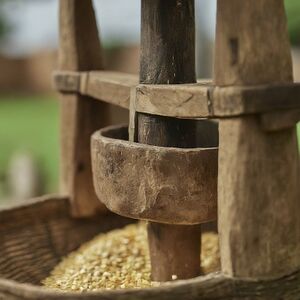

Related video(s): Hero fanning mill cleaning oats
Suggested citation for this chapter.
Garlough, J. (2022) Evaluation of low-cost fanning mills for cleaning seed. In Farmpedia, The Encyclopedia for Small Scale Farmers. Editor, M.N. Raizada, University of Guelph, Canada. farmpedia.org
Challenges of Cleaning Seed
Traditional cleaning of seeds from cereals such as rice, barley, and wheat is done through a series of different steps. Threshing is the separation of seeds from straw, husk, leaves, etc. (Slate Run Farm Posts, 2017). This can be done in a variety of ways, such as beating the grain heads on the floor, having livestock walk on the grain, or even spreading it out on the road so that cars separate the seed as they drive over it (Slate Run Farm Posts, 2017). This process is time-consuming and can require multiple people to complete in a timely manner. Wind winnowing is the next process, in which the chaff is removed from the seeds. In strong enough wind, the mix remaining after threshing is tossed into the air (India Environment Portal, 1998). The lightweight chaff is blown away, leaving the heavier seeds. This can be done using a shovel, a winnowing fork, or by hand using natural wind, or a winnowing fan can be used to create wind (India Environment Portal, 1998). This can be time-consuming, as it takes at least one person to be constantly working. Additionally, it cannot be done at any time: if there is no wind, the seed and chaff will simply fall to the ground unseparated, and if there is too much wind, the seeds and chaff will all blow away. A winnowing fan allows the right wind speed to be created for this process to be done effectively (Garlough, 2021). On the downside, the winnowing fan requires a person to operate it, making the minimum number of people involved two. A simple sieve or mesh can then be used to separate healthy seeds from any remaining chaff. This process is simple and cost-effective, as plastic meshes/sieves can be purchased for about one dollar. These processes are effective in separating seeds and grains; however, they can be very time-consuming. The use of a fanning mill could greatly decrease the time the seed cleaning process takes.
What is a Fanning Mill?
The fanning mill is a machine that makes use of a fan and a series of different sized meshes and grates to separate healthy seeds, diseased seeds, and chaff (The Globe and Mail, 1920). Fanning mills can be operated with a crank, with an individual turning it, or with an electric motor to do the work. The crank or motor is used to turn the fan and shake the grates (Garlough, 2021). The unsorted seeds are dumped in the hopper, where they are slowly released into the machine onto the shaking grates and blown down the machine by the wind created by the fan (Garlough, 2021). This allows the seeds to be separated from the chaff due to the difference in weight (The Globe and Mail, 1920). Due to its lightweight and larger size, the chaff is unable to fall through the grate with the seeds and is easily blown out of the machine by the fan (Garlough, 2021). In addition to removing the chaff, diseased and damaged seeds are also removed. Diseased seeds are often lighter than healthy seeds and, as a result, are blown away with the chaff (The Globe and Mail, 1920). Damaged seeds can sometimes make it through the first shaking grate but are removed once they reach the second, finer grate. The healthy seeds are then collected in a bag, trough, or bucket, depending on the make and style of the machine (Garlough, 2021).
Use of the Fanning Mill to Remove Diseased Seed
Smallholder farmers often face the difficulty of diseased crops. Bunts and smuts are a concern for these farmers in Africa, as they can greatly reduce a crop's yield, value, and marketability if not dealt with correctly (Agricultural Research Council, n.d.). A seed treatment process is available to prevent bunts and smuts (Agricultural Research Council, n.d.); however, farmers looking to save money, or those who cannot afford to have their seeds treated, may end up with infected crops. These diseases can be dealt with using a fanning mill: bunts and smut balls can be removed during the fanning process along with the chaff and anything else unwanted (Garlough, 2021). In addition to the balls being removed, diseased seeds are also blown, filtered, and separated during the milling process.
Cost/Benefit and Critical Analysis
A fanning mill would prove to be very beneficial to smallholder farmers. It can help farmers save money and avoid losing crops to disease by removing diseased seeds during the milling process. The price of a fanning mill can still be considerable for smallholder farmers in developing countries. Despite fanning mills being expensive for farmers, there are opportunities for them to obtain financial aid. A few of these options are purchasing through a farmer cooperative or a women's farmer group, or making use of a local fee-for-service entrepreneur who will sell the use of their fanning mill. Farmers could also make use of 50:50 cost sharing with their government or seek out a micro-loan program to assist in the purchase of a fanning mill. It is possible that a community of farmers could all split the cost of one of these machines, giving many of the farmers within the community access to more efficient methods of cleaning seeds and benefiting everyone. However, the heavy weight of these machines can make transportation to rural, mountainous areas very difficult. Literacy is also a requirement, as these machines require considerable training to operate effectively, and manuals must be available in the local language if they are to be of any use to farmers.
The cost of fanning mills can be expensive for smallholder farmers. However, the benefits of using a fanning mill would be considerable, as it would save crops from disease and save a lot of time that would otherwise be spent separating seeds using more traditional methods. On average, a woman can winnow 10-30 kilograms of grain each day (Food and Agriculture Organization, n.d.), while a fanning mill can clean 500 kg of seed per hour with one operator (Sun Agro, n.d.). In one hour, a fanning mill can clean between 16 and 50 times more seeds than one woman can in a day, meaning one hour of running the fanning mill could save 16 to 50 days of work for these women farmers. This is an incredible time saver and allows these women to perform other tasks with their time.

Compared to traditional methods of cleaning seed, Figure 1 shows three different fan options. The winnowing fan (Option 1) is a manual fan attached to a crank that can be turned at various speeds to allow another person to clean the seeds. This could be a good option, as it does not require waiting for winds strong or weak enough to clean seeds using natural wind (Benson, n.d.); however, it is a two-person job, since one person must operate the fan. By contrast, the small fanning mill (Option 2) is operated using a small crank that generates electricity to power the mill (Sun Agro, n.d.). It can be operated continuously by a single person. It is a more expensive option, and it is unlikely that many smallholder farmers will be able to purchase one on their own. The last option (Option 3), the fanning mill, is a much larger and more expensive version of the small fanning mill. It is purely electric and can process 4 times the amount of grain as the small fanning mill (Meena Industries, n.d.). It is very unlikely that any individual farmer would be able to purchase one on their own.
The fanning mills shown are electric; however, there are options that do not require electricity, which would allow farmers to cut down the cost of these machines (Garlough, 2021). A manual fanning mill operated by a crank would cost less, as the mill has no electric motor or electricity requirement to operate (Garlough, 2021), and any expensive motor repairs could also be avoided (Garlough, 2021). The development of solar-powered technology is much needed and would be massively beneficial in reducing operating costs. Additionally, fanning mills can also make use of a combustion engine instead of an electric one, allowing farmers who are not connected to a grid to use powered fanning mills as well.
Practical Resources to Get Started
References
1. Agricultural Research Council. (n.d.). Small grain diseases. Agricultural Research Council, South Africa. Link
2. Benson. (n.d.). Benson mild steel manual winnowing fan. Indiamart. Link
3. Cleaveland, N.S. (n.d.). Fanning-mill. Pioneergirl. Link
4. DanDem34 (Director). (2016). Chatham fanning mill [Video]. Link
5. Flaman Grain Systems. (n.d.). Link fanning mill. Link
6. Food and Agriculture Organization. (n.d.). Technical alternatives. Link
7. Garlough, J. (2021, September 30). Former Ontario Federation of Agriculture Director for Dundas County, Ontario, Canada. (J. Garlough, Interviewer).
8. Hutchins, C.A. (1871, November 7). Improvement in fanning mills. United States Patent Office. Link
9. India Environment Portal. (1998, November 14). Winnowing made easy. Link
10. Lacey, J. (2002, September 1). The fanning mill. Farm Collector. Link
11. Meena Industries. (n.d.). Iron automatic winnowing fan, 1HP, single phase. Indiamart. Link
12. Shuda, M. (Director). (2015). Hero fanning mill cleaning oats [Video]. Link
13. Slate Run Farm Posts. (2017, June 21). Threshing is done the old-fashioned way at Slate Run Living Historical Farm. Metro Parks. Link
14. Sun Agro. (n.d.). Sun Agro mild steel agriculture winnowing fan, 1 HP, electric. Indiamart. Link
15. The Globe and Mail. (1920, December 17). Fanning mill checks disease: By removal of light seeds and dirt it saves millions of dollars. The Globe and Mail, Toronto, Canada. Link