
Control of Cacao Swollen Shoot Virus
7.23 -Control of Cacao Swollen Shoot Virus
Madelynne Mitchell, University of Guelph, Canada
Suggested citation for this chapter.
Mitchell,M. (2026) Control of Cacao Swollen Shoot Virus, The Encyclopedia for Small Scale Farmers. Editor, M.N. Raizada, University of Guelph, Canada. farmpedia.org
Introduction
Economic Impact - Significance of the cacao sector
The global chocolate sector is a massive industry, marked by stark economic disparities and agricultural challenges. The economic significance of the cacao sector is highlighted by the difference between the value of raw export market of cacao beans and the finished processed chocolate market. While the finished chocolate market generates approximately $100 billion USD annually, the raw cacao exports are valued at only $9–12 billion USD (Bailey & Meinhardt, 2016), creating a 90% gap that results in an unstable financial situation for farmers. Although the value of cacao rises by an estimated 6,000% during the sale of chocolate versus bean exportation, which heavily favors merchants, the market revenue held by smallholder farmers has fallen by 16% from the 1980s (Borda et al., 2021). The industry remains highly reliant on a labour-intensive workforce, employing 40-50 million people worldwide and depending on 5-6 million smallholder farms operating on less than 6 hectares of land (Bailey & Meinhardt, 2016). Geographically, West Africa, primarily Côte d'Ivoire and Ghana, supplies approximately 70% of global cacao, making the crop a critical driver of local economic growth and a major source of government tax revenue through export taxes (Bailey & Meinhardt, 2016).
However, this sector is threatened by biological factors, with disease serving as the primary hindrance, accounting for an estimated annual yield loss of 30–40% globally (Gyamera et al., 2023). For decades, Cacao Swollen Shoot Virus (CSSV) has caused the eradication of millions of trees, resulting in lost production and resulting in it being the most financially destructive disease affecting the region's cacao sector (Bailey & Meinhardt, 2016).
Understanding Cacao Swollen Shoot Virus (CSSV) and its symptoms
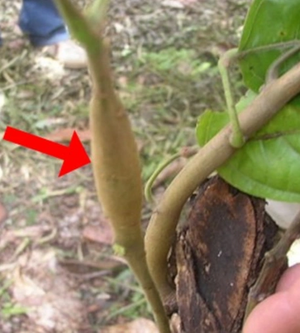
Cacao swollen shoot virus (CSSV) is a double-stranded DNA (dsDNA) virus belonging to the genus Badnavirus, family Caulimoviridae, and is a primary biological constraint on cacao production (Bailey & Meinhardt, 2016). The virus has non-enveloped bacilliform particles and a circular genome that targets the host's phloem companion cells and xylem parenchyma cells (Gyamera et al., 2023). The virus infiltrates the tree's vascular tissues, disrupting the integral pathways that distribute water and nutrients throughout the plant. This disruption causes distinct physical symptoms, including root and stem swelling (Figure 1, the origin of its name), as well as red vein banding on new foliage, and rounded, mottled pods (Gyamera et al., 2023).

Figure 1. Swollen stem on cacao following CSSV infection (Source: Wikipedia Commons, author DiSnouk, CC0) Link
Mealybug transmission and progression
CSSV is transmitted naturally by mealybugs (see Figure 2) within the family Pseudococcidae, with 14 species identified as vectors (Bailey & Meinhardt, 2016). In Ghana and Côte d’Ivoire, the most devastating transmitters are the cacao mealybug (Formicococcus njalensis), the citrus mealybug (Planococcus citri), and the striped mealybug (Ferrisia virgata) (Bailey & Meinhardt, 2016).

Figure 2. Mealybug on stem (Source: Pexels, CC0). Link
Although all life stages can spread the pathogen, young nymphs are particularly effective, acquiring and transmitting the virus in as little as 4 hours, although a 48-hour feeding period optimizes transmission (Bailey & Meinhardt, 2016). CSSV does not replicate within the mealybug itself, nor is it passed genetically to the vector's offspring (Bailey & Meinhardt, 2016). Disease CSSV transmits spatially via radial spread, meaning its movement outwards is spherical, from a single central infected tree. Because the mealybugs move slowly by crawling, they pass the virus to the immediately adjacent trees, creating a slowly growing, continuous patch of infection. Alternatively, it is spread by nymphs carried by wind, or transported by symbiotic ants where the wind blows the bugs far away to start a brand new circle of infection (Gyamera et al., 2023).
CSSV management strategies and evaluation
Phytosanitary control (roguing - cutting out)
The management of CSSV is a highly labor-intensive and costly endeavor, primarily because complete eradication of infected trees is required to ensure quarantine of viral infected sources (Bailey & Meinhardt, 2016). Techniques such as coppicing (see Figure 3), in which trees are cut close to the ground while maintaining the roots and new shoots to regrow the tree, are ineffective because the virus persists in the root system.

Figure 3. Example of coppicing - tree stumps with roots intact (Source: PxHere, CC0) Link
The entire tree must be killed to prevent infected shoots from reemerging and restarting the infection (Bailey & Meinhardt, 2016). In cases of severe outbreaks, mass deforestation is often necessary, followed by replanting with certified virus-free material (Bailey & Meinhardt, 2016). These seeds and deforestation services are often provided by the government and agricultural institutions. However, the success of these eradication campaigns is frequently hindered by funding gaps and farmer resistance, as farm owners are often hesitant to destroy healthy-looking trees during the latent infection period (Gyamera et al., 2023).
Biological Control [Mild Strain Cross-Protection (MSCP)]
An alternative approach is biological control, specifically mild-strain cross-protection (MSCP). Functioning like a vaccine, MSCP is the process of deliberately infecting cacao trees with a weakened, relatively harmless version of the virus. This early exposure establishes a biological defense, protecting the plants from future attacks by the severe, crop-destroying variations (Bailey & Meinhardt, 2016). Historically, this strategy has primarily targeted the New Juaben strain (Strain 1A), which is recognized as the most virulent and economically damaging CSSV variant in West Africa (Bailey & Meinhardt, 2016). In 1955, Posnette and Todd demonstrated that pre-infecting trees with mild strains successfully protected them against the Juaben isolate in Ghana (Bailey & Meinhardt, 2016). Building on this principle, field experiments in Ghana evaluated a barrier method in which uninfected cacao trees were surrounded by outer rows that had been ‘vaccinated’ with the mild N1 strain. This living buffer significantly reduced the spread of the severe 1A strain into interior trees compared with plots without perimeter protection (Agusto et al., 2024). Despite these successes, MSCP faces practical and ecological limitations. Because this immunity is highly strain-specific, it generally only protects against closely related variants. For example, mild strains from Ghana's Western Province often failed to cross-protect against severe strains from the Eastern Province (Bailey & Meinhardt, 2016). Given the high genetic diversity of CSSV, developing a comprehensive cross-protection strategy that accounts for all viral variants is considered highly impractical (Bailey & Meinhardt, 2016). Likewise, the deliberate, widespread dissemination of mild strains carries significant biological risks, including the danger that the attenuated virus could mutate into a more severe virus over time or interact with other viral strains to trigger even more severe symptoms through synergistic effects (Gyamera et al., 2023).
Chemical Control (insecticide application)
Chemical control, specifically insecticide application, has been explored as a method to manage CSSV transmission. This approach is severely limited by interconnected biological, economic, and safety challenges. Historically, researchers tested various chemicals, including nicotine, benzene hexachloride, and parathion (Gyamera et al., 2023). While parathion proved sufficient at reducing mealybug vector populations, it was ultimately deemed unviable due to its high toxicity to mammals and devastating impact on mealybug predators, resulting in severe ecosystem complications (Gyamera et al., 2023). Beyond ecological concerns, effectively targeting mealybugs has been shown to be difficult. Contact insecticides are largely ineffective because mealybugs are cryptic insects that hide deep within the canopy or in bark crevices, and their bodies are protected by waxy secretions that naturally repel liquid sprays (Gyamera et al., 2023). Therefore, systemic insecticides, such as Dimefox, which are absorbed directly into the plant's tissues, are considered ideal (Gyamera et al., 2023). Nevertheless, the industry has struggled to identify a systemic option that is safe to use, affordable, and that does not alter the flavour profile of the harvested cocoa beans (Bailey & Meinhardt, 2016).
Even if an ideal chemical were developed, profound practical and economic barriers would remain. Most smallholder farmers lack the financial capital to purchase commercial agrochemicals regularly. Thus, the economic and manual application of these chemicals is highly problematic, as unmaintained cacao trees routinely reach heights of 5 to 10 meters, and manually applying insecticides with standard backpack sprayers is laborious and unlikely for the average farmer (Gyamera et al., 2023).
Strategies for a more sustainable cacao sector
Integrated Pest Management (IPM) approach
The Integrated Pest Management (IPM) approach for the cacao sector represents a necessary paradigm shift from relying on isolated interventions and shifting to combining core management strategies for CSSV (Hebbar, 2007). IPM was the most effective solution for other fungal and oomycete diseases that affect cacao, such as Black Pod Rot, Witches' Broom, and Frosty Pod Rot (Bailey & Meinhardt, 2016). No single intervention or management strategy offers complete disease control. IPM integrates multiple methods to keep pathogen damage below economically significant thresholds while minimizing environmental and financial costs (Hoppen & Krauss, 2016). These include the previously mentioned removal of infected and neighbouring trees, biological control such as vaccines, and chemical control, including insecticides.
The greatest challenge to the IPM strategy is the transfer of technology and knowledge. Cacao is an orphan crop grown by millions of impoverished smallholders lacking access to government and institutional services (Hebbar, 2007). Consequently, IPM relies heavily on Farmer Field Schools (FFS), often funded through public-private partnerships involving governments, NGOs, and global chocolate manufacturers (such as Mars Inc. and the World Cocoa Foundation) (Hebbar, 2007). These schools provide hands-on training to farmers in complex techniques such as recognizing early disease symptoms, safe and rational pesticide application, proper pruning, and clonal grafting, which are required to make IPM effective in practice (Hebbar, 2007). These schools may present a local business opportunity for farmers who are fortunate enough to receive IPM training. Additionally, an increase in funding in areas of development around IPM infrastructure also creates opportunities for potential economic benefits if pest management allows for significant yield increases, restoring a large fraction of the lost 30–40% of yields globally (Gyamera et al., 2023). This economic benefit may provide some incentive for government or foreign aid investment, which may help sidestep potential economic barriers faced by farmers.
Practical Interventions - economic solutions/buffers
To enhance the economic resilience of resource-limited smallholder cacao farmers, the industry must integrate sustainable financial buffers alongside strengthened institutional policies and community organizations. Income diversification through agroforestry presents an essential economic solution. For instance, integrating commercial fruit trees, such as mandarin, avocado, mango, and African plum, into low-input cacao systems in Cameroon significantly increased profitability, provided a financial safety net, and acted as barrier crops against disease vectors as these trees are immune to CSSV – ultimately slowing and mitigating the spread of infection (Duguma et al., 2001). Similarly, the "Peru Cacao Alliance" successfully implemented a model in which farmers intercropped bananas to generate short-term income and provide necessary shade before young cacao trees matured (Borda et al., 2021).
Beyond crop diversification, optimizing farm inputs through rational chemical use, including timing fungicide applications to coincide with pest peaks rather than relying on calendar spraying, has successfully reduced disease incidence by 50-60% while decreasing overall chemical consumption and therefore cost (Bailey & Meinhardt, 2016).
Developing and distributing high-yielding, disease-resistant varieties is considered the most effective long-term strategy for smallholders; however, here progress has been hindered by cacao's status as an orphan crop with limited crossbreeding diversity to strengthen resistance, compounded by a general lack of modern agriculture education (Bailey & Meinhardt, 2016; Gyamera et al., 2023). Consequently, effective institutional governance and framework policies must be formalized to limit smallholder asset losses, providing sustained, long-term funding for farmer compensation and farm rehabilitation (Bailey & Meinhardt, 2016). This requires a divergence from historically flawed models like the 1970s "plant as you cut" program, which showed promise by having the government fell, replant, and maintain infected trees; however, the program suffered from inconsistent administration and limited funding. Therefore, modern policies must maintain these compensation efforts alongside strict containment strategies, such as establishing buffer zones, to prevent the spread of viruses like CSSV to new areas (Bailey & Meinhardt, 2016).
Finally, because the vast majority of cacao is cultivated by individual smallholders who lack the capital and resources to combat diseases effectively, strengthening community organizations is essential to facilitate technology transfer and reduce transaction costs (Borda et al., 2021; Duguma et al., 2001). Educational platforms like Farmer Field Schools are needed to train farmers to recognize early disease symptoms and understand the science behind IPM, thereby significantly increasing long-term agricultural sustainability (Gyamera et al., 2023). Networks known as Common Initiative Groups (GICs) ensure smallholder farmers’ economic survival (Duguma et al., 2001). In Cameroon, these GICs have proven highly successful at pooling harvests for bulk marketing, a strategy that drastically lowers assembly and transaction costs while significantly increasing the final prices paid to individual farmers (Duguma et al., 2001). By repurposing this cooperative framework from a purely economic marketing tool into an agricultural disease management system, farming communities can effectively organize shared labor pools, distribute the heavy financial burdens of removing diseased trees, and coordinate the bulk acquisition of new, disease-resistant seedlings to collectively overcome severe outbreaks (Duguma et al., 2001).
Helpful Links To Get Started
Link On site identification lecture
Link Fantastic resource for CSSV identification and local resources for infected tree removal Note- no details on location or regional constraints
Link Resources for control program (unified farmers)
Link General understanding
Link Free seeds, support for farmers, with subsidies and scholarships (unified farmers)
References
Agusto, F. B., Leite, M. C. A., Owusu-Ansah, F., Domfeh, O., Hritonenko, N., & Chen-Charpentier, B. (2024). Cacao sustainability: The case of cacao swollen-shoot virus co-infection. PLoS ONE, 19, e0294579. https://doi.org/10.1371/journal.pone.0294579
Bailey, B. A., & Meinhardt, L. W. (Eds.). (2016). Cacao Diseases: Cham, Switzerland: Springer. https://doi.org/10.1007/978-3-319-24789-2
Borda, A., Morales, O., Teegen, H., Rees, G. H., & González-Pérez, M. A. (2021). Addressing sustainable rural development with shared value: A Peruvian model from the cacao industry. Sustainability 13, 8028. https://doi.org/10.3390/su13148028
Cadby, J., & Araki, T. (2021). Towards ethical chocolate: multicriterial identifiers, pricing structures, and the role of the specialty cacao industry in sustainable development. SN Business and Economics, 1, 1-36. https://doi.org/10.1007/s43546-021-00051-y
Duguma, B., Gockowski, J., & Bakala, J. (2001). Smallholder Cacao (Theobroma cacao Linn.) cultivation in agroforestry systems of West and Central Africa: challenges and opportunities. In Agroforestry Systems 51, 177-188
Gonzales, M. V. A (2024). Cacao industry: Its status, opportunities and challenges. International Journal of Science and Management Studies (IJSMS), 7, 178–196. https://doi.org/10.51386/25815946/ijsms-v7i6p120
Gyamera, E. A., Domfeh, O., & Ameyaw, G. A. (2023). Cacao Swollen Shoot Viruses in Ghana. Plant Disease, 107, 1261–1278. https://doi.org/10.1094/PDIS-10-22-2412-FE
Hebbar, P. K. (2007). Cacao diseases: a global perspective from an industry point of view. Phytopathology, 97, 1658–1663. https://doi.org/10.1094/PHYTO-97-12-1658
Ten Hoopen, G. M., & Krauss, U. (2016). Biological control of cacao diseases. In Bailey, B. A., & Meinhardt, L. (Eds.). Cacao Diseases. (pp. 512–566). Retrieved from https://doi.org/10.1007/978-3-319-24789-2
In Bailey, B. A., & Meinhardt, L. (Eds.). Cacao Diseases. (pp. 512–566). Retrieved from https://doi.org/10.1007/978-3-319-24789-2