
Coconut Coir Pith: Waste to Effective Compost
4.36 - Coconut Coir Pith: Waste to Effective Compost
Amreet Boora, University of Guelph, Canada
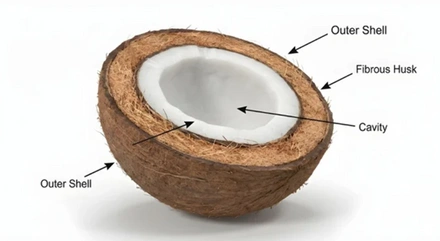
Figure 1. Coir pith is obtained from the fibrous husk of the dried coconut. Source: https://stock.adobe.com/images/coconut-anatomy/1835374511
Suggested citation for this chapter.
Boora, A. (2026) Coconut Coir Pith: Waste to Effective Compost. In Farmpedia, The Encyclopedia for Small Scale Farmers. Editor, M.N. Raizada, University of Guelph, Canada. farmpedia.org
Background
Soils in Africa and South Asia both suffer from soil degradation, erosion, poor nutrient quality, and a low water capacity of the roots (Lal, 2023). These problems affect smallholder farmers and are intensified due to extreme weather, which reduces productivity, yield, and the nutrient quality of crops (Lal, 2023). Reliance on tractors and motorized farming machines instead of animal traction, and use of chemical fertilizers instead of manure, have led soils to lose their organic matter and become hard and compacted, reducing yields (Derpsch et al., 2024). Coir pith is the outer fibre layer of a dried coconut husk and is primarily a waste product in agriculture (Priyadarshini et al., 2021) (see Figure 1).

Figure 1. Coir pith is obtained from the fibrous husk of the dried coconut. Source: https://stock.adobe.com/images/coconut-anatomy/1835374511
When coir pith is added to the soil as a compost, it absorbs water and nutrients, improves soil quality, and promotes crop yield, especially in dry areas (Prakash et al., 2021). Coconut coir pith compost (see Figure 2) can be made using a farmer's own supply of coconuts, or coir can be purchased locally. The compost is made by piling layers of coir pith with poultry manure and a decomposer, keeping the pile moist, and allowing it to break down into compost after one month (Access Agriculture, 2021). Producing coconut coir pith compost can provide additional income for farmers by allowing them to sell it to other farmers locally (Access Agriculture, 2021).

Figure 2. Composted coconut coir pith Source: https://www.istockphoto.com/photo/coconut-coir-compost-sustanable-potting-up-meadia-in-gardener-hands-gm1387331143-445302154
Benefits
Coir pith has a high ability to absorb water and nutrients, and a high moisture capacity, allowing it to hold 5-6 times its weight in water (Prakash et al., 2021). The application of composted coconut coir pith led to a 17% increase in maize yield due to its high moisture content (Kannan et al., 2013). For this reason, coir pith is highly beneficial in dry and drought-prone areas that experience a higher loss of nutrients (Prakash et al., 2021). Coir pith has a strong ability to effectively hold onto key mineral nutrients such as nitrogen, which is essential for healthy plant growth (Thomas et al., 2013; Prakash et al., 2021). In one study, it increased nitrogen content in the soil from 0.26% to 1.06% and added essential micronutrients (Kannan et al., 2013). Composted coir pith also contains essential nutrients such as potassium, sodium, calcium, and magnesium, which improve both the physical and chemical properties of the soil, along with crop yield (Thomas et al., 2013). Crops grown with coconut coir pith had increased vitamin C content, increasing from 7.5 to 11.4 mg per 100 g of fruit (Mogale & Maluleke, 2025). Coir pith compost reduces the risk associated with transplanting by making it easier to transplant seedlings without cutting or damaging the roots (Access Agriculture, 2021). Coconut coir pith also improves plant and crop growth by increasing microbiological activity in the soil and preventing soil erosion (Prakash et al., 2021). Working best in sandy loam soil with good aeration, tomatoes grown with coconut coir pith had greater fruit yield per plant, increasing from 6 to 21 fruits (Mogale & Maluleke, 2025).
How Can Coconut Coir Pith Be Adopted by Smallholder Farms?
Fibre is first extracted from the coconut husk, leaving behind coir pith (Access Agriculture, 2021). To accomplish this, soak coconut husks in water for several weeks, then once completely soaked, beat the husks finely (see Figure 3) with a strong wooden stick to separate the coir pith from the fibre (Access Agriculture, 2021). If accessible, to save time and labour, drive over the soaked coconut husks with a tractor to separate the coir pith from the fibre (Access Agriculture, 2021). Fibres can also be separated using a machine (see Figure 4) (approximately $1703 USD from online retailers like Alibaba) to improve efficiency and save time and labour for large-scale use of compost and a larger supply to sell for additional income (Access Agriculture, 2021).

Figure 3. Coconut husks beaten to separate coir pith from fibre Source: https://www.accessagriculture.org/coir-pith?cat_id=123

Figure 4. Fibres separated from the coconut husk using a coir fibre extracting machine Source: https://www.accessagriculture.org/coir-pith?cat_id=123
To avoid waste, the separated fibres can be used to make ropes and mats (Access Agriculture, 2021). If coconuts are not available in the farmer's local region, raw coir pith (see Figure 5) can be purchased locally from suppliers, coconut-processing industries, or factories, or imported through online retailers such as Alibaba and IndiaMART if logistics allow, at a cost of $8 to $12 USD per 5 kg block (Chen, 2026).

Figure 5. Raw coconut coir pith block Source: https://www.shutterstock.com/image-photo/compressed-bale-ground-coconut-shell-fibers-141767041
To prepare 100 kg of coir pith compost for a field of 200 square meters, collect the separated coir pith or purchased raw coir pith (add water to loosen the compacted block) and sieve it to remove any remaining fibres (Access Agriculture, 2021). Select a shaded area (such as under a tree) or sheltered area to create the compost by building five layers. Spread 20 kg of coir pith evenly (see Figure 6) and begin preparing an organic decomposer rich in microbes (which helps break down materials and make nutrients available for crops) with locally available materials (Access Agriculture, 2021).

Figure 6. Coir pith evenly spread under a shaded area Source: https://www.accessagriculture.org/coir-pith?cat_id=123
In South Asia, an indigenous compost formulation is created. Specifically, in a barrel or tub, add 100 L of water, 5 kg of cow manure, 10 mashed bananas, 3 L of cow urine, ½ kg of jaggery or raw sugar, ½ kg of flour, and a handful of soil (Priya et al., 2021). Mix this mixture (see Figure 7) twice a day and cover it so that it is ready after one week.

Figure 7. Prepared organic decomposer Source: https://www.accessagriculture.org/coir-pith?cat_id=123
After it is ready in one week, collect 10 L of the prepared organic decomposer and sprinkle it on the layer of coir pith, repeating this process for each of the five layers (see Figure 8) (Access Agriculture, 2021). To improve the nitrogen content, add 4 kg of decomposed poultry manure or urine. To speed up the composting, spread handfuls of cow manure over the layer (Access Agriculture, 2021). Add another layer of coir pith and repeat the whole process (Access Agriculture, 2021).
To save time and labour from preparing an organic decomposer, but with additional costs, it can be substituted by spreading 100 g of mushroom spawn, a living fungal mycelium to grow fungi ($3 to $10 USD per kg) or 100 g of powder of Trichoderma, a fungus that protects against disease ($20 to $40 USD per kg), that can be purchased locally (Priya et al., 2021). To keep the compost pile moist, continue to sprinkle water on it every day. Hold a handful of the compost and form a ball: if there is too much water, stop watering immediately; if it is too hard and dense, add more water to increase the moisture (Access Agriculture, 2021).

Figure 8. Organic decomposer added to each of the five layers Source: https://www.accessagriculture.org/coir-pith?cat_id=123
Open the compost pile every 10 days to allow fresh air to enter (Priya et al., 2021). After one month, the compost will be fully decomposed, with a dark colour (see Figure 9) and an earthy smell (Access Agriculture, 2021).

Figure 9. Decomposed coir pith compost is dark in colour with a soil-like texture (soft and slightly moist) Source: https://www.accessagriculture.org/coir-pith?cat_id=123
For field application, spread 100 kg of the decomposed compost to 200 square metres of soil (Priya et al., 2021). For new fruit trees, add a handful of coir pith compost into the planting pit with soil (Access Agriculture, 2021). For fruit trees up to 10 years old, apply 10 kg of coir pith compost (see Figure 10) every six months around the base of the tree (Priya et al., 2021). For trees older than 10 years, apply 15 kg of coir pith compost every six months around the base of the tree (Priya et al., 2021).

Figure 10. 10 kg of coir pith compost applied around the base of a tree (under 10 years old) Source: https://www.accessagriculture.org/coir-pith?cat_id=123
Critical Analysis
Coconut coir pith compost works best in sandy loam soils and in dry and drought-prone areas due to its high moisture content and ability to retain water and nutrients (Prakash et al., 2021). Coir pith composting is a long process that requires both time and labour due to multiple steps, including beating the coconut fibres, extensive washing, and layering ingredients to create the compost over the period of a month (Coir Board, 2016). Time and labour can be reduced by using machinery such as tractors or coir fibre separating machines (approximately $1703 USD). Though labour is required, coir pith composting supports the livelihoods of farmers, especially in coconut-producing regions (Coir Board, 2016). To improve efficiency while reducing time, labour, and costs, farmers in coconut-producing regions can work with cooperatives or local fee-for-service businesses by sharing equipment such as tractors or coir fibre extracting machines and locally purchasing coir pith or ready-made compost from neighboring farmers (FAO, 2012). Larger batches of coir pith compost can be produced collectively with neighboring farmers and mills, dividing the time, labour, and costs (FAO, 2002).
Working with machinery, the high noise and dust levels in coir processing environments are hazardous to workers, especially women, who make up the majority of coir workers (Sahu et al., 2019). Approximately 80% of coir workers are women, which means this field of work is highly dependent on female labour, which can affect their health and safety when handling the coir fibre and performing physically demanding tasks (Senthilkumar, 2015). Coir fibre extraction contributes to pollution and affects the health of the labourer through inhalation of the fibre when being separated from the coir pith (Coir Board, 2016). Consistent and long-term exposure can lead to increased respiratory symptoms and allergies (Panicker et al., 2010). Health concerns include respiration and muscular problems, with workers reporting prolonged coughs, water blisters, and 91% of workers experiencing pain throughout the body (Sahu et al., 2019). There is an increased presence of nasobronchial allergy among workers in the coir industry (Panicker et al., 2010). During the monsoon season, harmful chemicals such as tannins and salts can leach from piled coir pith and contribute to groundwater pollution and become difficult to remove (Coir Board, 2016). This is harmful to both humans and natural wildlife (Coir Board, 2016). Biodegradation is necessary, as high salinity levels in coir pith can create risks for crops if the coir is not washed properly (Coir Board, 2016).
The creation of coir pith compost relies on basic and locally available tools and resources such as coconuts, a wooden stick, a barrel, a bucket, water, cow urine, cow manure, bananas, sugar, flour, and soil (Access Agriculture, 2021). As already noted, substituting the organic decomposer mixture for ingredients such as mushroom spawn ($3 to $10 USD per kg) or Trichoderma powder ($20 to $40 USD per kg) adds additional costs (Access Agriculture, 2021). In regions without coconuts, purchasing raw coir pith (approximately $8 to $12 USD per 5 kg block) increases production costs (Chen, 2026). Co-composting coir pith with cow manure creates effective compost (Tripetchkul et al., 2012). Using coir pith compost compared to municipal compost in Tamil Nadu led to a 4% increase in net returns, suggesting the benefits may outweigh the costs (Kumaresan et al., 2001). Ultimately, compost from coir pith is highly sustainable and cost-effective, as it turns an agricultural waste product into high-quality compost and fertilizer (Pundee et al., 2023).
Practical Links & Resources to get Started
Coconut coir blocks – supplier on Alibaba.
Coir fibre separating machine – supplier on Alibaba.
Step by step video by Access Agriculture to get started.
One page factsheet for a quick summary of coir pith and the steps to create coir pith compost.
References
Access Agriculture. (2021). Coir pith. DOI
Chen, M. (2026, January 11). How to choose the best coco peat blocks: A complete buying guide. Alibaba. DOI
Coir Board. (2016). Coir pith wealth from waste a reference. Kochi, Kerala. DOI
Derpsch, R., Kassam, A., Reicosky, D., Friedrich, T., Calegari, A., Basch, G., Gonzalez-Sanchez, E., & dos Santos, D. R. (2024). Nature's laws of declining soil productivity and conservation agriculture. Soil Security, 14, 100127. DOI
FAO. (2002). Coir Processing Technologies. FAO Open Knowledge Repository. Food and Agricultural Organization of the United Nations, Rome. DOI
FAO. (2012). Agricultural cooperatives: Paving the way for food security and rural development. Food and Agricultural Organization of the United Nations, Rome. DOI
Kannan, K., Selvi, V., Singh, D. V., Khola, O. P. S., Mohanraj, R., & Murugesan, A. (2013). Coir pith composting - an alternate source of organic manure for rainfed maize. Central Soil & Water Conservation Research & Training Institute, India. DOI
Kumaresan, M., Kumar, P. H., Shnamurthy, V. K., & Athinarayanan, R. (2001). Effect of composted coir pith, nitrogen and irrigation on chewing tobacco (Nicotiana tabacum). Indian Journal of Agronomy, 53(3), 223–228. DOI
Lal, R. (2023). Restoring South Asia's degraded soils and ecosystems for peace and prosperity. Journal of Soil and Water Conservation, 78(5), 97A-102A. DOI
Mogale, J. T., & Maluleke, M. K. (2025). The effect of varying coconut coir substrates and loam soil on the physiology, and biochemical constituents of tomato (Solanum lycopersicum var. Esculentum) grown under greenhouse environment. Discover Sustainability, 6(1), 143. DOI
Panicker, V., Karunakaran, R., & Ravindran, C. (2010). Nasobronchial allergy and pulmonary function abnormalities among coir workers of Alappuzha. The Journal of the Association of Physicians of India, 58, 420–422. DOI
Prakash, D. V., Dr. JR Kavitha, R Kamaleshwaran, P Prabharan, & Alagendran, D. S. (2021). Effect of coir pith compost in agriculture. Journal of Medicinal Plants Studies, 9(4), 106–110. DOI
Priya, L., Selvam, Aruna, K., & Senthilkumaran. (2021). Coir pith - wealth from waste. Access Agriculture. DOI
Priyadarshini, V., Felixkala, T., Depaa, R. A. B., Hemamalinie, A., Francis Xavier, J., Surendra Babu, K., & Jeya Arthi, A. J. (2021). Experimental investigation on properties of coir pith and its influence as partial replacement of fine aggregate in concrete. Materials Today: Proceedings, 45, 6903–6906. DOI
Sahu, S., Parida, C., & Mishra, J. (2019). Study on health hazards of workers in coir industry. The Pharma Innovation Journal, 8(6), 28–30. DOI
Senthilkumar, R. (2015). Problems and prospects of coir industry. Asia Pacific Journal of Research, 1(34), 201-205. DOI
Thomas, G. V., Palaniswami, C., Prabhu, S. R., Gopal, M., & Gupta, A. (2013). Co-composting of coconut coir pith with solid poultry manure. Current Science, 104(2), 245–250. DOI
Tripetchkul, S., Pundee, K., Koonsrisuk, S., & Akeprathumchai, S. (2012). Co-composting of coir pith and cow manure: Initial C/N ratio vs physico-chemical changes. International Journal of Recycling of Organic Waste in Agriculture, 1(1), 15. DOI