
Climbing Chayote Squash on Terrace Walls
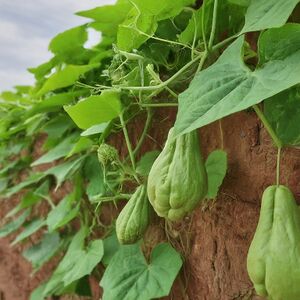
3.2b - Climbing chayote squash on terrace walls
Nicholas Dischiavi, University of Guelph, Canada

Related video(s): Wall crops (English) (Source: SAK Global)
Suggested citation for this chapter.
Dischiavi, N. (2022) Climbing chayote squash on terrace walls. In Farmpedia, The Encyclopedia for Small Scale Farmers. Editor, M.N. Raizada, University of Guelph, Canada. farmpedia.org
Background on Terrace Farming
Terrace farming is not an ideal method of production for many smallholder farmers due to high labour and limited horizontal growing area (Chapagain and Raizada, 2017). However, growing crops vertically along terrace walls represents an opportunity for subsistence farmers to increase their production per hectare, as well as their profits (Chapagain et al., 2019).
In mountainous regions, terrace farming has been utilized for thousands of years due to its ability to prevent soil erosion, conserve water, and increase productivity, especially with limited land space (Deng et al., 2021). The first evidence of terrace farming was in Southeast Asia some 5000 years ago, with the practice subsequently extending to the Mediterranean's northern and southern borders, and with extensive evidence of terrace agriculture by the Incas in the New World (Price and Nixon, 2005). Terrace farming is most commonly designed as follows: a vertical wall is built along the mountain/hillside, and on top of the terrace is a horizontal plot of land where field crops can be grown (Chapagain et al., 2019). To allow for the growth of such crops (e.g. grains, horticultural crops, and fodder), steep slopes (typically of the hillside) are split into narrow, graded steps (Chapagain et al., 2019). In addition, the ledge at the base of the vertical wall can be left as a walkway or can be utilized to grow climbing and/or hanging plants (Chapagain et al., 2019), which is the topic of this chapter.
Background to Chayote Squash
Chayote (Sechium edule), a member of the Cucurbitaceae family, is believed to have originated in Central America (Pu et al., 2021). To this day, it remains unknown exactly where chayote was first domesticated, but it is still common among Central American countries such as Guatemala, Costa Rica, and Mexico (Vieira et al., 2019). Past research incorrectly identified Guatemala as the birthplace of chayote, yet current research supports the theory that it was cultivated by the Mayans in Southern Mexico (Pu et al., 2021). Due to the location in which chayote originated, it grows best in semi-tropical climates but can also be adapted to grow in tropical climates (Pu et al., 2021). However, European explorers spread chayote across the globe, planting it in the Caribbean, South America, and parts of Europe, and over time, farmers adapted to grow chayote in Asian and African countries as well (Pu et al., 2021). Conveniently, chayote can be consumed in full, as all parts of the plant are edible, including its tuberous roots (Pu et al., 2021). These roots are prepared after one year of growth and contain significant amounts of starch and dietary fibre (Pu et al., 2021).
Growth and Production of Chayote
Like other Cucurbitaceae, chayote grows on a perennial vine (Vieira et al., 2019). These vines grow very aggressively, up to 6-9 m in a given season, and produce 50-100 squash per plant (Vieira et al., 2019). Further, what is particularly nice about chayote is that seeds can be found inside the fruit and replanted for future yields. Chayote can take many different shapes, with variation in colour, size, and texture. As a warm-season fruit, chayote should be planted about one month after the last sign of frost, if relevant (Vieira et al., 2019). To grow fully, chayote requires 4 to 5 months of direct sunlight, yet it can also grow in partial sunlight, though this would in turn reduce the yield (Pu et al., 2021). For best results, chayote should be planted in soil with a pH between 6-6.8 (Pu et al., 2021).
Cost-Benefit Analysis of Growing at the Base of Terrace Walls
In a study by Chapagain et al. (2019), climbing chayote squash was planted at the base of terrace walls over two cropping seasons to test its potential growth and overall value. Taking place in Nepal, the researchers attempted to grow climbing pumpkins, yams, and chayote in two separate locations (Chapagain et al., 2019). Chayote was by far the most profitable of the three, as fruit weight totalled approximately 166 kg per plant, while tubers totalled about 16 kg (Chapagain et al., 2019).
Although chayote is relatively affordable to grow, there are expenses that reduce potential earnings (Chapagain et al., 2019). Using the study by Chapagain et al. (2019), researchers were able to model potential earning outcomes in USD. In the Dhading block of Nepal, transportation to market alone cost $11.40 per plant on average (2015-16 average). The cost of labour was about $3.45, while seeds and planting materials were around $0.35 (Chapagain et al., 2019). Altogether, including miscellaneous costs, the expenses of growing and selling chayote were about $16.55 in the Dhading block, while the net return was approximately $32.95 per plant (Chapagain et al., 2019). Not only could the fruit be sold, but the chayote tuber was also valued at $0.40/kg in the Dhading region (Chapagain et al., 2019). The cost of maintaining the terrace itself must be considered as well, including labour and materials.
Sustainability of Terrace Farming
A major challenge is that terraces require constant maintenance, or else they deteriorate, requiring considerable labour and cost to restore (Deng et al., 2021), as noted above. Over time, terraces can interrupt water circulation, including promoting run-off and soil loss, if not well-maintained (Deng et al., 2021). To operate as intended, a terrace must be used in unison with soil conservation practices, especially in wet climates (Durán Zuazo et al., 2019). Significant environmental issues brought on by poorly designed or poorly managed terraces could cause soil loss up to five times that of a well-managed terrace. The terrace must be protected by vegetation, or plant covers must be implemented to preserve it (Durán Zuazo et al., 2019). In this vein, the chayote vertical canopy may help protect terrace walls, but studies are needed to confirm this. Failure to maintain the terrace could lead to the deterioration of soil and pose issues in the future for farmers hoping to reuse that land.
Limitations
Unfortunately, chayote squash is not the most profitable commodity for remote farmers. Although it has the potential for great economic return, transportation of the fruit in remote areas cuts profits tremendously, as noted above (Chapagain et al., 2019). Chapagain et al. (2019) found in their trial that almost 70% of the overall cost of growing chayote was allocated to transportation from the hillside to markets, due to the substantial mass of both the squash and the tubers. This shows the importance of remote farmers developing market channels and/or working relationships with potential consumers. Alternatively, some type of post-harvest processing or preservation without refrigeration could add value to this crop and reduce immediate transportation costs (e.g. pickling).
The issue of storage is a common problem for chayote farmers, especially those harvesting excess fruit (Cadena-Iñiguez et al., 2006). As chayote fruit is soft and high in moisture content, the seed can germinate prematurely inside the fruit (vivipary), about a week after storage under non-ideal environmental conditions (Cadena-Iñiguez et al., 2006). Cold storage or wax coating were found to prevent this premature sprouting (Cadena-Iñiguez et al., 2006).
The design of the terrace can pose challenges to farmers as well. It is recommended that farmers select an angled terrace wall to minimize the possible effect of monsoon rainfall on the terrace, and the potential for soil erosion (Pu et al., 2021). This is not common knowledge among all farmers and runs the risk of damaging their soil and/or terrace. In a financial sense, it is also important to consider the cost of materials used for terrace construction, and the possibility of damaging the soil while building it (Deng et al., 2021). Uninformed farmers could create a non-sustainable terrace that could lead to the potential ruin of crops and loss of their investment.
Although farmers in Nepal have already begun to grow climbing and hanging crops on terrace walls, experts have yet to fully analyze the true potential economic gains from these yields, so this form of farming requires testing in other environments (Chapagain et al., 2019). The cost of building a new terrace is especially concerning, and hence this practice should only be undertaken on farms with pre-existing terraces. The Sustainable Agriculture Kits for Terrace Farmers in Nepal initiative offers valuable resources (Government of Canada, 2021).
Conclusion
When evaluating the economic success of subsistence farmers growing chayote squash on terrace walls, it is evident that the potential for profit is high, as long as there are pre-existing terrace walls available and post-harvest and transportation solutions available to take advantage of the high yield of this cropping system.
Picture Based Lesson to Train Farmers

Links to Useful Resources
Short YouTube film displaying the practice of terrace farming in Nepal
Article on a terrace farming initiative in Nepal
Article on sustainable agriculture kits
Article on the health benefits of chayote
YouTube video showing how to grow chayote vines vertically
YouTube video sharing recipes for cooking chayote
YouTube video showing the function of a terrace farm on a hillside
References
1. Cadena-Iñiguez, J., Arévalo-Galarza, L., Ruiz-Posadas, L.M., Aguirre-Medina, J.F., Soto-Hernández, M., Luna-Cavazos, M., & Zavaleta-Mancera, H.A. (2006). Quality evaluation and influence of 1-MCP on Sechium edule (Jacq.) Sw. fruit during postharvest. Postharvest Biology and Technology, 40(2), 170-176. DOI
2. Chapagain, T., Ghimire, B., Pudasaini, R., Gurung, K., Choi, K., Rai, L., Magar, S., Bishnu, B.K., & Raizada, M.N. (2019). The underutilized terrace wall can be intensified to improve farmer livelihoods. Agronomy for Sustainable Development, 39(3), 29. DOI
3. Deng, C., Zhang, G., Liu, Y., Nie, X., Li, Z., Liu, J., & Zhu, D. (2021). Advantages and disadvantages of terracing: A comprehensive review. International Soil and Water Conservation Research, 9(3), 344-359. DOI
4. Durán Zuazo, V.H., Rodríguez Pleguezuelo, C.R., Rodríguez, B.C., Ruiz, B.G., Gordillo, S.G., Sacristán, P.C., Tavira, S.C., & García-Tejero, I.F. (2019). Terraced subtropical farming: Sustainable strategies for soil conservation. In Soil Health Restoration and Management (pp. 231-278). DOI
5. Government of Canada. (2021, March 9). Sustainable agriculture kits for terrace farmers in Nepal. International Development Research Centre (IDRC), Ottawa. Retrieved September 29, 2022. Link
6. Price, S., & Nixon, L. (2005). Ancient Greek agricultural terraces: Evidence from texts and archaeological survey. American Journal of Archaeology, 109, 665-694. Link
7. Pu, Y.-T., Luo, Q., Wen, L.-H., Li, Y.-R., Meng, P.-H., Wang, X.-J., & Tan, G.-F. (2021). Origin, evolution, breeding, and omics of chayote, an important Cucurbitaceae vegetable crop. Frontiers in Plant Science, 12, 739091. DOI
8. Vieira, E.F., Pinho, O., Ferreira, I.M., & Delerue-Matos, C. (2019). Chayote (Sechium edule): A review of nutritional composition, bioactivities, and potential applications. Food Chemistry, 275, 557-568. DOI