
Breadfruit As a New Crop
2.19 - Breadfruit As a New Crop
Jasper Roy, University of Guelph, Canada
Suggested citation for this chapter.
Roy,J. (2026) Breadfruit As a New Crop. In Farmpedia, The Encyclopedia for Small Scale Farmers. Editor, M.N. Raizada, University of Guelph, Canada. farmpedia.org
What is Breadfruit?
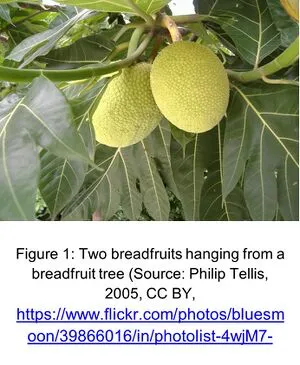
Grown on trees that can range from 10 to 18 meters tall (Fig. 1 & 2) depending on the variety (Solomon & Government of the Republic of Trinidad and Tobago, 2017), breadfruit, also known as Artocarpus altilius (Yang et al., 2022), is a starchy crop domesticated in the Pacific Islands (Słota et al., 2025). It originates in Polynesia and the surrounding island regions. Africa has a native species of breadfruit known as African breadfruit (Treculia africana) that originated in the tropics and subtropics of Africa. The difference is that Polynesian breadfruit contains higher carbohydrate contents and is therefore preferred (Nwokolo, 1996).
Figure 1

Figure 1: Two breadfruits hanging from a breadfruit tree (Source: Philip Tellis, 2005, CC BY, Flickr).
Figure 2

Figure 2: One breadfruit still attached to a short breadfruit tree (Source: Leonora (Ellie) Enking, 2010, CC BY, Flickr).
Through colonial human migration, breadfruit can now be found being farmed beyond the Pacific Islands and has become an essential crop in regions such as the Caribbean and Central America, Africa, and Southeast Asia (Słota et al., 2025). Breadfruit can be compared to a cantaloupe in size and is full of carbohydrates and micronutrients that are often deficient in many places in the world; these micronutrients include magnesium, calcium and Vitamin A, all of which are essential to human health (Słota et al., 2025).
Figure 3

Breadfruit is also quite versatile as a cooking ingredient and can be prepared in a number of ways (Figure 3). A few of the most popular ways to prepare breadfruit are roasting (Jamaica), "oil-down" (Trinidad and Tobago), curried (Guyana and Trinidad), frying, soups, chips, etc. (Roberts-Nkrumah & Badrie, 2004). It can also be processed into a gluten-free flour while maintaining its nutritional properties, but the process is very labour intensive (Słota et al., 2025).
Why Choose Breadfruit as a Smallholder Farmer?
Farming: Breadfruit trees can be propagated through a number of ways, such as the planting of seeds, naturally occurring root shoot and root cuttings (National Tropical Botanical Garden, 2022). Refer to Propagation: Step-By-Step section (below) for more detail.
Nutritional Benefits: Breadfruit is an excellent source of macronutrients such as carbohydrates—specifically complex carbohydrates like fibre—and is a complete protein, meaning that breadfruit contains all the necessary amino acids our bodies need (Ragone, 2014). Overall, 25% of fiber recommended for daily intake can be found in 100 g of breadfruit, as well as up to an additional 4% in protein and 6% in micronutrients (Ragone, 2014). As a protein source, breadfruit surpasses cassava and is similar to other valuable protein crops like sweet potato, banana and plantain (Mehta et al., 2023). Below is a short list highlighting some of the most potent nutrients in breadfruit (Ragone, 2014):
Table 1: Breadfruit Nutritional Properties (Source: Diane Ragone, 2014, Link).

A full list of nutrients and a graph comparing breadfruit to white potato and white rice can be found in the table link above.
Medicinal Properties: Breadfruit trees are as multifaceted in medicinal uses as they are in the kitchen. The indigenous peoples of the Pacific Islands developed this hundreds of years ago and continue to use all parts of the tree to treat a number of medical conditions such as internal and external inflammation, circulatory health, and potentially tumors (Badrie & Broomes, 2010). Below is a list of the most important parts of the breadfruit tree and its medicinal uses:
Leaves
Leaves from breadfruit trees can be crushed and used to make soothing oils to help bruising, massaging sore muscles or broken bones, and, if roasted, can be consumed to treat an enlarged spleen (Badrie & Broomes, 2010). Can also aid with liver health, stabilize blood pressure and soothe headaches and earaches (Badrie & Broomes, 2010).
Latex (a.k.a. Gum)
Traditionally used to treat open wounds, can be mixed with water and consumed to treat diarrhea, and acts against fungal infections in the skin (Badrie & Broomes, 2010). Sap of a similar consistency can be used to treat ear infections (Badrie & Broomes, 2010).
Bark
Oral histories from Pacific Islanders say that the bark can be used to treat headaches, but unfortunately, the application of this technique has been lost to time (Badrie & Broomes, 2010). Studies are being done around extracting potent substances from breadfruit tree bark to treat leukemia (Badrie & Broomes, 2010).

Figure 4: Freshly cut jackfruit exposing latex much like breadfruit. (Source: Vis M., 2013, Wikimedia Commons, Link).
Marketing: Breadfruit has both local and international sale opportunities as interest grows worldwide. For a smallholder farmer, mature breadfruit trees can be a good source of income from local markets, because of the tree having two harvest seasons per year (Taylor et al., 2019a). Prices vary based on location, so it is difficult to give a definitive number in terms of profitability. But it has been observed that imported rice and wheat might become sparser with climate change, meaning that the demand for breadfruit and breadfruit products is predicted to rise (Taylor et al., 2019c). On one hectare of land with around 100 breadfruit trees, a farmer can produce 16 – 20 tonnes of breadfruit per year (Taylor et al., 2019c). There are many factors that may cause harvests to fluctuate within this range such as tree care, tree maturity and the variety being grown (Taylor et al., 2019c). Unfortunately, the international sale of breadfruit is difficult due to the extensive means necessary to prevent the fruit from going bad during the export process (Taylor et al., 2019a).
How to Plant and Maintain Breadfruit
Before covering the steps, there are a few things that need to be taken into consideration before planting and raising breadfruit trees, like the season/weather, soil type and how long the whole process will take, as well as the required equipment:
Soil
Breadfruit trees thrive best in soils that are:
Well-drained soils
Well-drained soils allow for water and oxygen to reach the roots of the tree. Since breadfruit trees typically keep their roots closer to the surface, this is beneficial (Ragone, 2011). A farmer can usually tell if a soil will drain water well if the texture of the soil feels closer to sand or silt rather than clay which will clump together (Steil, 2024).
Fertile
Luckily for breadfruit farmers, these trees are not very competitive in nature except for with each other. As a result of this, a good way to maintain fertility in soil is by intercropping with common, regional vegetables and letting the remnants of the plants decompose in the field (Taylor et al., 2019b).
pH
Breadfruit grows best in soil that sits between a 6.1 and 7.4 range on the pH scale (Ragone, 2011). The best way to test a soil's pH is through at-home testing kits (refer to the Cost and Equipment Needed section for more).
Season / Weather
Breadfruit trees love bimodal rainfall, meaning two rainy seasons and two intervening dry seasons per year. This allows mature trees to have 1 to 2 harvests per year—a bigger one during the warm rainy season and a slightly smaller harvest 3 or 4 months following the first one (Ragone, 2011). It is recommended that farmers transfer their saplings from the smaller bed used to raise them into the actual field right as the first rainy season is about to begin (Ragone, 2011). In the case of a late season, go ahead with planting the trees, and instead, water them manually for the first 1 to 3 months with irrigation methods best suited to the field (Ragone, 2011).
Table 2: Cost and equipment chart (Source: IndiaMART)


Propagation: Step-By-Step
Most varieties of domesticated breadfruit farmed today do not contain seeds. Seeded breadfruit is still grown, but in order to propagate breadfruit trees from those seeds, they would need to be planted in a pot almost immediately after being removed from the fruit as they quickly lose their germination ability (National Tropical Botanical Garden, 2022). Once planted in a pot with permeable soil, the sapling should begin to sprout in about 2 weeks (National Tropical Botanical Garden, 2022) (Figure 5). Shoots will grow directly from the tree's roots and appear from the soil, making them an ideal form of propagation. The ideal height to look for in a shoot is around 30 cm tall.

Figure 5: A breadfruit tree shoot (Source: The Breadfruit Institute, Diane Ragone, 2006, CC BY, http://www.traditionaltree.org).
The shoot must then be delicately removed by detaching the mother root from the tree, leaving 10 to 15 cm between the shoot and the point of severance (National Tropical Botanical Garden, 2022).
If the tree does not produce shoots by itself, do not worry. Sometimes the mother tree will not produce shoots unless it thinks its roots are injured.
As the rainy season begins, look for roots that are around 3 cm thick and carefully sever them into segments of around 15 to 30 cm in length (National Tropical Botanical Garden, 2022). Root thickness and length of segments can be slightly smaller or slightly larger and not have an impact on the shoot's growth. The root diameter can be as small as 1.5 centimeters and as large as 6 centimeters.
Finding the roots of the mother tree should be easy, since breadfruit trees keep their roots near the surface of the soil.
Once the root is severed, it will use the nutrients stored inside to sprout a shoot and propagate itself (National Tropical Botanical Garden, 2022). Before then, it must be planted in loose, shallow soil to allow for the water and air to reach it. Depending on the farmer's preference, it may be planted vertically to promote a shoot growing from the root's severed end, or it can be planted horizontally with a small section of the root above ground from which the shoots will grow (National Tropical Botanical Garden, 2022; Ragone, 2006).
Linked below is a straightforward guide of how to dig up breadfruit tree roots, sever them and plant them. The most important section in the video is from 0:00 to 1:40.
Anissa Lucero. (2022, December 21). How to make breadfruit trees – Adventitious root shoot propagation [Video]. YouTube. Link
Transplanting to the Field
As previously mentioned, breadfruit roots tend to remain in shallow soils, so digging up sapling roots for transplanting into the field is fairly simple (Ragone, 2011).
Start at the base of the sapling and gently unearth its thin roots. Generally, when transplanting any plant, it is recommended to water it first to make the soil stick to the roots and prevent any from breaking (Flemer, 1982). Since breadfruit trees, even saplings, have thicker roots, it is up to the farmer's preference.
With the roots fully out of the soil, dig a hole in the field where you would like to plant the sapling. The hole should be two times wider than the root system, but just slightly deeper than the root system (National Tropical Botanical Garden, 2022). The roots will spread horizontally rather than seeking deeper soil.
Fill in the hole and, if possible, water the sapling to help it adapt to its new soil (Flemer, 1982).
Critical Analysis
Pests, Diseases, and the Cost to Prevent Them

Figure 6: Seychelles scale living on a tree (Source: User Obsidian Soul, 2011, Wikimedia Commons, Link).
Seychelles Scale (Figure 6) – Pest
Likely to appear on leaf stems and under leaves, typically out of the sun (Jackson, n.d.-b).
Symptoms: Yellowing leaves, slowed or stopped shoot growth, discoloured and misshapen fruit (Jackson, n.d.-b).
Prevention: Make sure low-hanging branches and leaves are not touching the ground. Otherwise, ants will climb onto the leaves and feed the worms (Jackson, n.d.-b). For shorter varieties, this may not be possible. Boil water and pour it carefully onto ant colonies near the trees to remove them (Jackson, n.d.-b).
Natural Interventions: Beetles like ladybirds are natural predators of this pest, so regions that are commonly affected by scale will introduce ladybird beetles to control the population (Jackson, n.d.-b).
Cercospora Leaf Spot (Figure 7) – Disease

Appears on leaves as a result of too much/too little shade, too much heat and rainfall, and poor soil drainage (Tsatsia & Jackson, n.d.).
Symptoms: Green, red and orange fuzzy spots (Tsatsia & Jackson, n.d.). Can result in poor fruit growth, leaf growth and stem growth (Tsatsia & Jackson, n.d.).
Prevention: Manage tree shading, soil drainage, and soil nutrients. Weeds in the field can also contribute to leaf spotting (Tsatsia & Jackson, n.d.).
Phytophthora Fruit Rot (Figure 8) – Disease

Figure 8: Papaya Phytophthora blight (Source: Scot Nelson, 2011, CC BY, Flickr).
Occurs as a result of heavy rainfall causing soil which may carry the mould spores to reach the fruit (Jackson, n.d.-a).
Symptoms: White, black and blue mould growing on the underside of the fruit (Jackson, n.d.-a). Mould makes fruit inedible and is therefore a pressing issue.
Prevention: Low-hanging fruit are most likely to be affected, so make sure branches are properly pruned so they don't touch the ground (Jackson, n.d.-a). Placing a circle of mulch around the base of the tree can prevent the spores from splashing fruit in the case of rainfall (Jackson, n.d.-a).
Adoption of a New Crop
Adopting a crop that is new to a specific region can make some farmers weary, and understandably so. However, let it be remembered that breadfruit has already been adopted in multiple places in the world and has been integrated into many popular, cultural dishes in those regions. For more information on how this has been done, refer back to the What is Breadfruit? section of the chapter.
Helpful Links to Get Started
References
Badrie, N., & Broomes, J. (2010). Chapter 33 - Beneficial uses of Breadfruit (Artocarpus altilis): Nutritional, Medicinal and Other Uses. Bioactive Foods in Promoting Health (491–505).
Flemer, W. (1982). Successful Transplanting is Easy. Arboriculture & Urban Forestry, 8(9), 234–240. DOI
Jackson, G. (n.d.-a). Breadfruit Phytophthora fruit rot (130). Fact Sheet Fusion V2. Australian Centre for International Agricultural Research. Link
Jackson, G. (n.d.-b). Breadfruit (Seychelles) scale (242). Fact Sheet Fusion V2. Australian Centre for International Agricultural Research. Link
Mehta, K. A., Quek, Y. C. R., & Henry, C. J. (2023). Breadfruit (Artocarpus altilis): Processing, nutritional quality, and food applications. Frontiers in Nutrition, 10, 1156155. DOI
National Tropical Botanical Garden. (2022). Breadfruit: Tree to Table. National Tropical Botanical Garden. Link
Nwokolo, E. (1996). African breadfruit (Treculia africana Decne) and Polynesian breadfruit (Artocarpus altilis Fosberg). In: Nwokolo, E., Smartt, J. (ed.), Food and Feed from Legumes and Oilseeds, pp. 345–354. DOI
Ragone, D. (2006). Artocarpus altilis (breadfruit), ver. 2.1. In: Elevitch, C.R. (ed.). Species Profiles for Pacific Island Agroforestry. Permanent Agriculture Resources (PAR), Hōlualoa, Hawai'i. http://www.traditionaltree.org.
Ragone, D. 2011 (revised). Farm and Forestry Production and Marketing Profile for Breadfruit (Artocarpus altilis). In: Elevitch, C.R. (ed.). Specialty Crops for Pacific Island Agroforestry. Permanent Agriculture Resources (PAR), Holualoa, Hawai'i. Link
Ragone, D. (2014). Breadfruit Nutritional Value and Versatility. Hawai'i Homegrown Food Network. National Tropical Botanical Garden. Link
Roberts-Nkrumah, L., & Badrie, N. (2004). Breadfruit consumption, cooking methods and cultivar preference among consumers in Trinidad, West Indies. Food Quality and Preference, 16(3), 267–274. DOI
Słota, P., Pejcz, E., & Harasym, J. (2025). Bioactive Profile and Rheological Characteristics of Breadfruit (Artocarpus altilis) Pulp Commercial Flour. Molecules, 30(18), 3732. DOI
Solomon, F. Jr. (2017) Breadfruit Production. Technical Bulletin, Government of the Republic of Trinidad and Tobago. Link
Steil, A. (2024). Testing and Improving Soil Drainage. Iowa State University Extension and Outreach. Link
Taylor, M., Beyer, R., & McGregor, A. (2019a). The Guide: Market Opportunities. Australian Centre for International Agricultural Research. Link
Taylor, M., Beyer, R., & McGregor, A. (2019b). Breadfruit Compendium: Establishing a Breadfruit Agroforestry Orchard. Australian Centre for International Agricultural Research. Link
Taylor, M., Beyer, R., & McGregor, A. (2019c). Breadfruit Guide: The Basics. Australian Centre for International Agricultural Research. Link
Tsatsia, H., & Jackson, G. (n.d.). Algal leaf spot (148). Fact Sheet Fusion V2. Australian Centre for International Agricultural Research. Link
Yang, L., Zerega, N., Montgomery, A., & Horton, D. E. (2022). Potential of breadfruit cultivation to contribute to climate-resilient low latitude food systems. PLoS Climate, 1(8), e0000062. DOI