Natural Control of Fall Armyworms (Spodoptera frugiperda)
7.21 -Natural Control of Fall Armyworms (Spodoptera frugiperda)
Carter Long, University of Guelph, Canada
Suggested citation for this chapter.
Long,C. (2026) Natural Control of Fall Armyworms (Spodoptera frugiperda), The Encyclopedia for Small Scale Farmers. Editor, M.N. Raizada, University of Guelph, Canada. farmpedia.org
Introduction and context to fall armyworms in Africa and South Asia
Fall armyworms (Spodoptera frugiperda) are an invasive caterpillar pest that has spread across Africa and Asia since 2016 and threatens millions of maize farmers each year. In Africa, fall armyworms have caused maize yield losses upwards to ~11.5%. This is estimated to be around 9.4 billion USD of yield losses, which is a lot of money lost for farmers. These losses can be even higher in countries such as 26% in Ghana and 35% in Zambia (Harrison et al., 2019; Harrison et al., 2022).

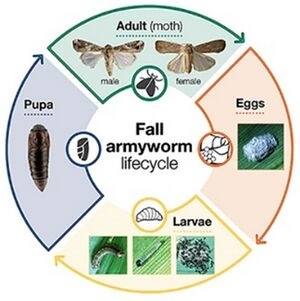
Figure 1. Life cycle of fall armyworm showing, egg, larva, pupa, and adult stages (Source: Agricultural Research Council, 2023).
The larval stage causes the most crop damage, so natural control methods for them should be the main target (FAO, 2017). The caterpillars feed on maize leaves and young plant tissues, which can reduce and kill plants if the infestation is severe (Harrison et al., 2019). It can feed on more than 80 different species, but maize is the main target because it is so widely grown (FAO, 2017). Adult moths also pose a threat, because they can travel up to 100 km and lay hundreds of eggs in one night. In infested fields, farmers should find shredded leaves and holes in the whorl (younger shoot composed of the base of leaves), with larvae deep inside the maize. The damage from fall armyworms usually looks worse than it is, as maize plants are able to recover from some of the damage to the leaves, especially if the plant is healthy and is growing properly (Access Agriculture, 2018).
Some farmers use chemical pesticides and spray their fields, but it is seen as a risk and poor fit for lower income farms (Yang et al., 2021). A reason for this is that larvae hide deep into the maize whorl where pesticides cannot reach, leaving the armyworm to feed and kill the plant; sprays are not recommended for this reason (FAO, 2017). Pesticides also increase health risks if the farmer is spraying without protective clothes. Finally, with heavy pesticide usage, it can kill natural predators and parasitoids, such as ants, lady bugs, spiders, and parasitic wasps, which in turn can make outbreaks even worse as farmers are not able to rely on these predators to lower the armyworm population in an outbreak (Harrison et al., 2019; Abbas et al., 2022). This is why the usage of natural methods aims to work with the farmers’ ecosystem already in place, instead of against it. These methods are low cost and rely on the protection of natural predators, using plant-based sprays.
Benefits of Natural Control
Natural control methods have low costs and help protect biodiversity, while reducing fall armyworm damage by around 30-50% in select smallholder farms, where multiple natural strategies are combined (Harrison et al., 2019, Chawanda et al., 2023). Studies show that fields with more natural predator diversity can lower the pest population (Abbas et al., 2022). These include parasitoid wasps who lay eggs inside armyworm larvae, which eventually kills them, with parasitism rates reaching 30-45% (Access Agriculture; Abbas et al., 2022).
Different microorganisms also help control infestations. Many bug killing fungi naturally fight and infect fall armyworms. In addition, the bacterium Bacillus thuringiensis produces a toxin that kills larvae after they feed on the maize leaves. These have been studied as safer alternatives than pesticides when attempting to control fall armyworms, with Bacillus thuringiensis mortality rates comparable to synthetic pesticides (Abbas et al., 2022).
These methods reduce costs for farmers and support biodiversity, while lowering the reliance of chemical pesticides, which helps reduce production costs in smallholder farms (Yang et al., 2021). Overall, fields that contain a variety of different plants and insects often result in lower pest populations, and can also improve maize yields 10-20% in some cases (Harrison et al., 2019).
How Farmers Can Implement Natural Control
Many methods are available to the farmer, but it is best when these practices are used together.
1. Monitor and check fields often
a. Especially during the early stages of the plant. During the first 6 weeks maize development, plants are the most vulnerable to pest damage and should be checked visually at least once or twice per week for the presence of egg masses and/or small larvae inside the maize whorl (i.e. young shoot consisting of wrapped around leaves) (FAO, 2017).

Figure 2. Fall armyworm egg mass on maize leaf, and freshly hatched larvae (Abbas et al., 2022).
2. Remove egg masses or larvae by hand
a. When checking the plants, and you see egg masses or larvae, you should remove them and crush them before they are able to spread. It is better to do this at an early stage, because as when they grow, they become more difficult to kill; early killing thus lowers the number of caterpillars later (Access Agriculture, 2018).


Figure 3. Fall armyworm hidden in whorl of maize (Access Agriculture, 2026).
3. Protect and support natural predators
a. Farmers should protect and support natural predators and avoid spraying pesticides unless absolutely needed. These predators should be relied on to keep pest numbers at a low level (Harrison et al., 2019; Abbas et al., 2022).
b. Farmers can promote natural predators to support their fields in a few ways. Leaving plant leaves around the field can provide shelter for earwigs and beetles, as well cooking fats rubbed into the stem of the maize can attract ants which eat larvae (Access Agriculture, 2018).
4. Using plant-based sprays & local mixtures
a. Plant-based sprays can be made from natural ingredients in the wild. Plants such as chili, neem, wild marigold, aloe vera, and other strong smelling or bitter plants in the area are used, and help repel adult moths, but results differ by how it is prepared and applied (Isman, 2020).
b. A homemade concoction process is the following:
- Collect the natural ingredients and chop them up on a clean surface, put them into a pot with 6 liters of water over fire, and boil it for about an hour.
- Let the mixture cool down a bit, and then mix and sift, then, add in a small package of tobacco snuff (which contains natural insecticide) into the mixture and mix for an additional 5 minutes.
- Ensure that there are no particles left in the mixture by sifting it through many times.
- When completed, pour the mixture into a 5-liter bottle and cover the lid with plastic, tie it on and put it in the shade, then after a day, check on the mixture and poke a small hole in the plastic at the top of the bottle to let the gases out.
- After a week, go back to check it: it should be ready to use as a spray. Since the mixture is powerful, one must dilute it with water. For 1 liter of mix, add 20 liters of water.
- When spraying the field, ensure you wear long sleeves and pants to protect skin from the spray to prevent irritation. The field should be sprayed once at least every week and during the early stages of plant growth if possible (Access Agriculture, 2018).
c. Another mixture that is not a spray is used to go deep into the whorl of the plant and is made with local ingredients consisting of:
- Tobacco, ash, and sand and mix it together in a bag.
- Sprinkle this mixture into the whorl of the growing maize plant.
- In turn this should kill and prevent armyworms from hiding deep in the whorls where sprays cannot reach (Access Agriculture, 2018).
5. Overall, doing all these methods will drastically help naturally defend against armyworm infestations and kill them, instead of relying on only one practice (Chawanda et al., 2023).
Critical Analysis and Limitations of these methods
One limitation of natural control methods is the labour required for them. Although they save money and are better for the biodiversity of the field, they require a lot of time spent checking fields, removing egg masses, and collecting ingredients and preparing local mixtures. These work well on smaller farms, but for larger fields with limited labour, it may take too much time (FAO, 2017). Another limit is how much natural control can help in the case of a severe outbreak. As an invasive species, the number of fall armyworms can rise extremely quickly in certain conditions. This includes moths traveling from nearby infested fields and laying thousands of eggs in or near a neighboring field. In this case, natural control methods may reduce damages but will not fully be able to control the infestation entirely on their own (Abbas et al., 2022).
These methods are useful, but do not work in every field with the same effectiveness. For example, in Malawi and Zambia, it was found that fall armyworm damage varied by farm and season, and the maize yield could not be predicted accurately just from the leaf damage (Harrison et al., 2022). Furthermore, in Ghana, neem-based products worked better than local mixtures, where ash, soil, and soap did not consistently reduce larvae and yield loss (Babendreier et al., 2020). Unfortunately, unlike in South Asia, neem is not widely available in many parts of Africa. Natural control is helpful but depends on different factors and should not be seen as the only solution to kill fall armyworms.
Conclusion
Overall, natural control methods for killing fall armyworms are not perfect, but they offer a safer and cheaper way to reduce infestations and damage. The main benefit is helping farmers protect their farms early in the growing season, as to reduce the amount of yield loss while protecting and encouraging natural predators onto farms. When combinations of these methods are combined, natural control becomes an extremely important part of smallholder farming systems.
Helpful Links To Get Started
References
Abbas, A., Ullah, F., Hafeez, M., Han, X., Dara, M. Z. N., Gul, H., & Zhao, C. (2022). Biological control of fall armyworm, Spodoptera frugiperda. Agronomy, 12(11), 2704. https://doi.org/10.3390/agronomy12112704
Access Agriculture (2026) Killing fall armyworms naturally. Link
Agricultural Research Council. (n.d.). Fall armyworm lifecycle. Link
Babendreier, D., Agboyi, L., Beseh, P., Osae, M., Nboyine, J., Ofori, S. E. K., Frimpong, J. O., Attuquaye Clottey, V., & Kenis, M. (2020). The efficacy of alternative, environmentally friendly plant protection measures for control of fall armyworm, Spodoptera frugiperda, in maize. Insects, 11(4), 240. Link
Chawanda, G., Tembo, Y. L. B., Donga, T. K., Kabambe, V. H., Stevenson, P. C., & Belmain, S. R. (2023). Agroecological management of fall armyworm using soil and botanical treatments reduces crop damage and increases maize yield. Frontiers in Agronomy, 5, 1114496. Link
Food and Agriculture Organization of the United Nations. (2017). Integrated management of the fall armyworm on maize: A guide for farmer field schools in Africa. Food and Agriculture Organization of the United Nations, Rome. Link
Harrison, R. D., Thierfelder, C., Baudron, F., Chinwada, P., Midega, C., Schaffner, U., & van den Berg, J. (2019). Agro-ecological options for fall armyworm (Spodoptera frugiperda J. E. Smith) management: Providing low-cost, smallholder friendly solutions to an invasive pest. Journal of Environmental Management. 243, 318-330. Link
Harrison, R. D., Baudron, F., Chinwada, P., Midega, C., Schaffner, U., & van den Berg, J. (2022). Low impact of fall armyworm (Spodoptera frugiperda Smith) (Lepidoptera: Noctuidae) across Smallholder Fields in Malawi and Zambia. Journal of Economic Entomology, 115(6), 1783-1791. Link
Isman, M. B. (2020). Botanical insecticides in the twenty-first century—fulfilling their promise? Annual Review of Entomology, 65, 233-249. Link
Yang, X., Wyckhuys, K. A. G., Jia, X., Nie, F., & Wu, K. (2021). Fall armyworm invasion heightens pesticide expenditure among Chinese smallholder farmers. Journal of Environmental Management, 282, 111949. Link